Question
The de-Broglie wavelength of a particle having kinetic energy $E$ is $\lambda$. How much extra energy must be given to this particle so that the de-Broglie wavelength reduces to $75 \,\%$ of the initial value ?

Answer

$\lambda=\frac{{h}}{{mv}}=\frac{{h}}{\sqrt{2 {mE}}}, {mv}=\sqrt{2 {mE}}$

$\lambda \propto \frac{1}{\sqrt{{E}}}$ $\frac{\lambda_{2}}{\lambda_{1}}=\sqrt{\frac{{E}_{1}}{{E}_{2}}}=\frac{3}{4}, \lambda_{2}=0.75 \lambda_{1}$

$\frac{{E}_{1}}{{E}_{2}}=\left(\frac{3}{4}\right)^{2}$

${E}_{2}=\frac{16}{9} {E}_{1}=\frac{16}{9} {E} \quad\left({E}_{1}={E}\right)$

Extra energy given $=\frac{16}{9} {E}-{E}=\frac{7}{9} {E}$

Need a full question paper?

Generate a complete, print-ready paper with questions like this in minutes — across 16+ boards, with answer keys.

Start Generating Free

Similar questions

When the temperature of a rod increases from $t$ to $\left( {t + \Delta t} \right)$, its moment of inertia increases from $I$ to $\left( {I + \Delta I} \right)$. If $\alpha $ be the coefficient of linear expansion of the rod, then the value of $\left( {\frac{{\Delta I}}{I}} \right)$ is
Which of the following figures correctly depicts the direction of magnetic field of a current-carrying coil ?
In photoelectric effect if the intensity of light is doubled then maximum kinetic energy of photoelectrons will become
An $\alpha$ particle is moving along a circle of radius $R$ with a constant angular velocity $\omega $. Point $A$ lies in the same plane at a distance $2R$ from the centre. Point $A$ records magnetic field produced by $\alpha$ particle. If the minimum time interval between two successive times at which $A$ records zero magnetic field is $‘t’,$ find the angular speed $\omega $, in terms of $t.$
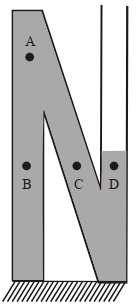
Consider a mercury-filled tube as shown in the figure below 

Which of the following options about the pressures at the lettered locations $(A, B, C, D)$ is true?
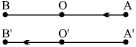
Two short bar magnets of magnetic moments $m$ each are arranged at the opposite corners of a square of side $d$ such that their centres coincide with the corners and their axes are parallel. If the like poles are in the same direction, the magnetic induction at any of the other corners of the square is
Two particles undergo $SHM$ along parallel lines with the same time period $(T)$ and equal amplitudes. At a particular instant, one particle is at its extreme position while the other is at its mean position. They move in the same direction. They will cross each other after a further time
Two long parallel conductors $S_{1}$ and $S_{2}$ are separated by a distance $10 \,cm$ and carrying currents of $4\, A$ and $2 \,A$ respectively. The conductors are placed along $x$-axis in $X - Y$ plane. There is a point $P$ located between the conductors (as shown in figure).

A charge particle of $3 \pi$ coulomb is passing through the point $P$ with velocity

$\overrightarrow{ v }=(2 \hat{ i }+3 \hat{ j }) \,m / s$; where $\hat{i}$ and $\hat{j} \quad$ represents unit vector along $x$ and $y$ axis respectively.

The force acting on the charge particle is $4 \pi \times 10^{-5}(-x \hat{i}+2 \hat{j}) \,N$. The value of $x$ is
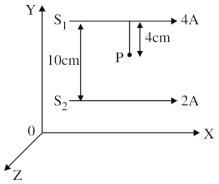
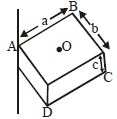
Figure shows a uniform solid block of mass $M$ and edge lengths $a, b$ and $c$. Its $M.I.$ about an axis through one edge and perpendicular (as shown) to the large face of the block is
$A$ block of mass $m$ moving with a velocity $v_0$ on a smooth horizontal surface strikes and compresses a spring of stiffness $k$ till mass comes to rest as shown in the figure. This phenomenon is observed by two observers:

$A$: standing on the horizontal surface

$B$: standing on the block 

According to observer $B$, the potential energy of the spring increases