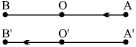
Two particles undergo $SHM$ along parallel lines with the same time period $(T)$ and equal amplitudes. At a particular instant, one particle is at its extreme position while the other is at its mean position. They move in the same direction. They will cross each other after a further time
Advanced
Download our app for free and get startedPlay store
The particle which is at mean position. Its $SHM$ can be represented by $x_{1}=-A \sin \omega t$. And the particle which is at extreme position. Its $SHM$ is represented by $x_{2}=A \cos \omega t$ When both cross each other

$x_{1}=x_{2}$

$\Rightarrow-A \sin \omega t=A \cos \omega t$

$\Rightarrow \tan \omega t=-1$

$\Rightarrow \omega t=-\frac{\pi}{4}, \frac{3 \pi}{4}$

$\omega t=-\frac{\pi}{4}$ will give the negative value of time which is not possible.

so

$\omega t=\frac{3 \pi}{4}$

$\Rightarrow \frac{2 \pi}{T} t=\frac{3 \pi}{4}$

$\Rightarrow t=\frac{3 T}{8}$

art

Download our app
and get started for free

Experience the future of education. Simply download our apps or reach out to us for more information. Let's shape the future of learning together!No signup needed.*

Similar Questions

  • 1
    A body of mass $1\,kg$ is executing simple harmonic motion. Its displacement $y(cm)$ at $t$ seconds is given by $y = 6\sin (100t + \pi /4)$. Its maximum kinetic energy is ..... $J$
    View Solution
  • 2
    The time period of a second's pendulum is $2\, sec$. The spherical bob which is empty from inside has a mass of $50\, gm$. This is now replaced by another solid bob of same radius but having different mass of $ 100\, gm$. The new time period will be .... $\sec$
    View Solution
  • 3
    The equation of $SHM$ of a particle is given as

    $2\,\frac{{{d^2}x}}{{d{t^2}}} + 32x = 0$

    where $x$ is the displacement from the mean position of rest. The period of its oscillation (in seconds) is

    View Solution
  • 4
    A rod of mass $‘M’$ and length $‘2L’$ is suspended at its middle by a wire. It exhibits torsional oscillations; If two masses each of $‘m’$ are attached at distance $‘L/2’$ from its centre on both sides, it reduces the oscillation frequency by $20\%$. The value of ratio $m/M$ is close to
    View Solution
  • 5
    Two masses ${m_1}$ and ${m_2}$ are suspended together by a massless spring of constant k. When the masses are in equilibrium, ${m_1}$ is removed without disturbing the system. Then the angular frequency of oscillation of ${m_2}$ is
    View Solution
  • 6
    A particle of mass m is under the influence of a force $F$ which varies with the displacement $x$ according to the relation $F = - kx + {F_0}$ in which $k$ and ${F_0}$ are constants. The particle when disturbed will oscillate
    View Solution
  • 7
    If $x=5 \sin \left(\pi t+\frac{\pi}{3}\right) \mathrm{m}$ represents the motion of a particle executing simple harmonic motion, the amplitude and time period of motion, respectively, are
    View Solution
  • 8
    $2$ particles $p$ and $q$ describe $SHM$ of same amplitude $a$ and same frequency $f$ along straight line, the maximum distance between the two particle $a\sqrt 2 $ . The initial phase difference between particle is
    View Solution
  • 9
    A $15 \,g$ ball is shot from a spring gun whose spring has a force constant of $600 \,N/m$. The spring is compressed by $5 \,cm$. The greatest possible horizontal range of the ball for this compression is .... $m$ ($g = 10 \,m/s^2$)
    View Solution
  • 10
    A horizontal platform with an object placed on it is executing $S.H.M$. in the vertical direction. The amplitude of oscillation is $3.92 \times {10^{ - 3}}m$. What must be the least period of these oscillations, so that the object is not detached from the platform
    View Solution