Question
The decay constant of a radioactive sample is $\lambda.$ The half$-$life and the average$-$life of the sample are respectively$:$

Answer

The half$-$life of a radioactive sample $\Big(\text{t}_{\frac{1}2{}}\Big)$ is defined as the time elapsed before half the active nuclei decays.
Let the initial number of the active nuclei present in the sample be $N_0.$
$\frac{\text{N}_{0}}{2}=\text{N}_{\text{0}}\text{e}^{-\lambda\text{t}_{\frac{1}2{}}}$
$\Rightarrow\text{t}_{\frac{1}{2}}=\frac{\text{In}2}{\lambda}$
Average life of the nuclei, $\text{t}_{\text{av}}=\frac{\text{S}}{\text{N}_{0}}=\frac{1}{\lambda}$
Here, $S$ is the sum of all the lives of all the $N$ nuclei that were active at $t = 0$ and $\lambda$ is the decay constant of the sample.

Need a full question paper?

Generate a complete, print-ready paper with questions like this in minutes — across 16+ boards, with answer keys.
Start Generating Free

Similar questions

When two magnetic moments are compared using equal distance method the deflections produced are $45^{\circ}$ and $30^{\circ}.$ If the length of magnets are in the ratio $1: 2,$ the ratio of their pole strengths is
 
Which type of current is flowing through a circuit?
The V-i graph for a conductor makes an angle θ with V-axis. Here V denotes the voltage and i denotes current. The resistance of conductor is given by(a) sin θ(b) cos θ(c) tan θ (d) cot θ
       
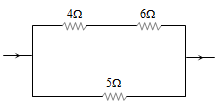
In the circuit shown in figure, the heat produced in $5$ ohm resistance is $10$ calories per second. The heat produced in $4$ resistance is
What is the color of the interference fringe nearest to the central maximum in case the source light is white?
A steady electric current is flowing through a cylindrical conductor.
  1. The electric field at the axis of the conductor is zero.
  2. The magnetic field at the axis of the conductor is zero.
  3. The electric field in the vicinity of the conductor is zero.
  4. The magnetic field in the vicinity of the conductor is zero.
The focal lengths of the objective and eye-lens of a microscope are 1 cm and 5 cm respectively. If the magnifying power for the relaxed eye is 45, then the length  of the tube is(a)  30 cm(b)  25 cm(c)  15 cm(d)  12 cm
       
In a nuclear reaction some mass converts into energy. In this reaction total B.E of reactants when compared with that of products is:
A plane electromagnetic wave with a single frequency moves in vacuum in the positive x direction. Its amplitude is uniform over the yz plane. the amplitude of its magnetic field. 
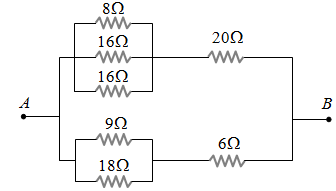
The equivalent resistance of the arrangement of resistances shown in adjoining figure between the points $A$ and $B$ is