The decreasing order of reactivity of $m-$ nitrobromobenzene $(I), 2, 4, 6-$ trinitrobromo-benzene $(II), p-$ nitrobromobenzene $(III)$, and $2,4-$ dinitrobromobenzene $(IV),$ towards $OH^-$ ions is
Medium


Download our appand get started for free
Experience the future of education. Simply download our apps or reach out to us for more information. Let's shape the future of learning together!No signup needed.*
Similar Questions
- 1$(i)$ chlorobenzene is mono-nitrated to $M$View Solution
$(ii)$ nitrobenezene is mono-chlorinated to $N$
$(iii)$ anisole is mono-nitrated to $P$
$(iv)\, 2-$ nitrochlorobenzene is mono-nitrated to $Q.$
Out of $M, N, P$ and $Q$ the compound that undergoes reaction with $aq. NaOH$ fastest is - 2View SolutionNitrobenzene at room temperature is
- 3View SolutionWhich of following is not correct ?
- 4A compound $(x)$ with molar mass $108 \mathrm{~g} \mathrm{~mol}^{-1}$ undergoes acetylation to give product with molar mass $192 \mathrm{~g} \mathrm{~mol}^{-1}$. The number of amino groups in the compound $(\mathrm{x})$ is . . . .. .View Solution
- 5View SolutionGive the product of the following reaction sequence

- 6View SolutionWhich does not give isocyanide test ?
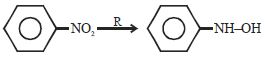
- 7$R$ isView Solution
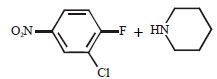
- 8The main product of following reaction will beView Solution
(image) $\to $ Product
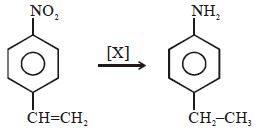
- 9In the given reaction $[X]$ isView Solution
- 10$STATEMENT-1$: Aniline on reaction with $\mathrm{NaNO}_2 / \mathrm{HCl}$ at $0^{\circ} \mathrm{C}$ followed by coupling with $\beta$-naphthol gives a dark blue coloured precipitate. andView Solution
$STATEMENT-2$: The colour of the compound formed in the reaction of aniline with $\mathrm{NaNO}_2 / \mathrm{HCl}$ at $0^{\circ} \mathrm{C}$ followed by coupling with $\beta$-naphthol is due to the extended conjugation.