The deflection in a moving coil galvanometer is
Easy


Download our appand get started for free
Experience the future of education. Simply download our apps or reach out to us for more information. Let's shape the future of learning together!No signup needed.*
Similar Questions
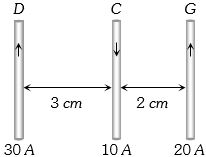
- 1Three long, straight parallel wires carrying current, are arranged as shown in figure. The force experienced by a $25\, cm$ length of wire $C$ isView Solution
- 2The electric current in a circular coil of four turns produces a magnetic induction $32\,T$ at its centre. The coil is unwound and is rewound into a circular coil of single turn, the magnetic induction at the centre of the coil by the same current will be $..........\,T$View Solution
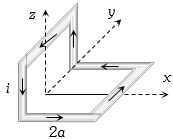
- 3A non-planar loop of conducting wire carrying a current $I$ is placed as shown in the figure. Each of the straight sections of the loop is of length $2a$. The magnetic field due to this loop at the point $P$ $(a,0,a)$ points in the directionView Solution
- 4View SolutionA current carrying rectangular coil is placed in a uniform magnetic field. In which orientation, the coil will not tend to rotate
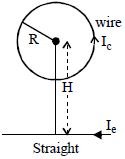
- 5Circular loop of a wire and a long straight wire carry currents $I_c$ and $I_e$, respectively as shown in figure. Assuming that these are placed in the same plane, the magnetic fields will be zero at the centre of the loop when the separation $H$ isView Solution
- 6The magnetic field at the origin due to a current element $i\,\overrightarrow {dl} $ placed at position $\vec r$ isView Solution
$(i)\,\,\left( {\frac{{{\mu _0}i}}{{4\pi }}} \right)\left( {\frac{{d\vec l\, \times \,\vec r}}{{{r^3}}}} \right)$
$(ii)\,\, - \left( {\frac{{{\mu _0}i}}{{4\pi }}} \right)\left( {\frac{{d\vec l\, \times \,\vec r}}{{{r^3}}}} \right)$
$(iii)\,\left( {\frac{{{\mu _0}i}}{{4\pi }}} \right)\left( {\frac{{\,\vec r \times d\vec l}}{{{r^3}}}} \right)$
$(iv)\, - \left( {\frac{{{\mu _0}i}}{{4\pi }}} \right)\left( {\frac{{\,\vec r \times d\vec l}}{{{r^3}}}} \right)$
- 7When a current of $5\ mA$ is passed through a galvanometer having a coil of resistance $15\ \Omega$, it shows full scale deflection. The value of the resistance to be put in series with the galvanometer to convert it into to voltmeter of range $0 - 10\ V$ isView Solution
- 8A long straight metal rod has a very long hole of radius $‘a’$ drilled parallel to the rod axis as shown in the figure. If the rod carries a current $‘i’$ find the value of magnetic induction on the axis of the hole, where $OC = c$View Solution
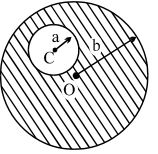
- 9A galvanometer, having a resistance of $50 \,\Omega$ gives a full scale deflection for a current of $0.05\, A$. The length in meter of a resistance wire of area of cross-section $2.97× 10^{-2} \,cm^2$ that can be used to convert the galvanometer into an ammeter which can read a maximum of $5\, A$ current is (Specific resistance of the wire = $5 × {10^{ - 7}}\,\Omega m$)View Solution
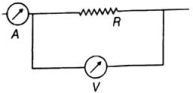
- 10In the adjoining circuit diagram, the readings of ammeter and voltmeter are $2\, A$ and $120 \,V$, respectively. If the value of $R$ is $75\, \Omega$, then the voltmeter resistance will be $\Omega$View Solution