MCQ
The density of a solid ball is to be determined in an experiment. The diameter of the ball is measured with a screw gauge, whose pitch is $0.5 \ mm$ and there are $50$ divisions on the circular scale. The reading on the main scale is $2.5 \ mm$ and that on the circular scale is $20$ divisions. If the measured mass of the ball has a relative error of $2 \%$, the relative percentage error in the density is
  • A
    $0.9 \%$
  • B
    $2.4 \%$
  • $3.1 \%$
  • D
    $4.2 \%$

Answer

Correct option: C.
$3.1 \%$
c
Given

Screw gauge readings

Pitch $=0.5 \ mm$

Circular scale division $=50$

Main scale reading $=2.5 \ mm$

Least count $=\frac{0.5}{50}=0.01 \ mm$

Circular scale division reading $=2$ odivisions

Relative error $=2 \%$

So,

Then dimensions reading from screw gauge $=$ Diameter of a solid ball

S.G. Reading $=$ main scale reading $+\left(\frac{\text { pitch }}{\text { circular scale division }}\right) \times$ circular scale division reading

$\text { Diameter of solid ball }=2.5+\frac{0.5}{50} \times 20=2.7 \ mm$

As density $\rho=\frac{\text { mass }}{\text { Volume }}=\frac{M}{\frac{4 \pi}{3}\left(\frac{D}{2}\right)^3}$

The relative percentage error in the density is

$\frac{\Delta \rho}{\rho} \times 100=\left(\frac{\Delta M }{ M }+\frac{3 \Delta D }{ D }\right) \times 100$

$\% \text { error }=\left(\frac{\Delta M }{ M } \times 100+\frac{3 \Delta D }{ D }\right) \times 100$

$=\left(2+3 \times \frac{0.01}{2.7}\right) \times 100$

$=3.1 \%$
Need a full question paper?

Generate a complete, print-ready paper with questions like this in minutes — across 16+ boards, with answer keys.

Start Generating Free

Similar questions

The ratio of the weight of a man in a stationary lift and when it is moving downward with uniform acceleration $‘a’$ is $3 : 2$. The value of $‘a’$ is ($g-$Acceleration due to gravity of the earth)
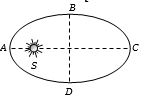
A planet is revolving around the sun as shown in elliptical path

The correct option is

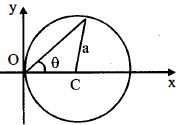
A particle is moving in a circular path of radius $a,$ with a constant velocity $v$ as shown in the figure.The centre of circle is marked by $'C'$. The angular momentum from the origin $O$ can be written as
Two concentric shells have masses $M$ and $m$ and their raddi are $R$ and $r$ respectively where $R > r$, if $x$ be the distance from the common centre, then what is the gravitational potential at a point for which $r < x < R$
The $SI$ unit of the inductance, the henry cannot be written as
The diameter and height of a cylinder are measured by a meter scale to be $12.6 \pm 0.1\, cm$ and $34.2  \pm  0.1\, cm$, respectively. What will be the value of its volume in appropriate significant figures?
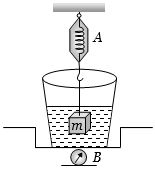
The spring balance $A$ reads $2\, kg$ with a block m suspended from it. $A $ balance $B$ reads $5 \,kg $ when a beaker filled with liquid is put on the pan of the balance. The two balances are now so arranged that the hanging mass is inside the liquid as shown in figure. In this situation
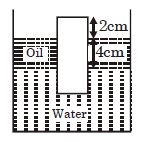
A cylinder of radius $4\ cm$ and height $10\ cm$ is immersed in two liquids as shown. Specific gravity of oil is $0.5$ . $2\ cm$ of cylinder is in the air. Select the $INCORRECT$ statement. Neglect atmospheric pressure.
If $\vec P = \vec Q$ then which of the following is NOT correct
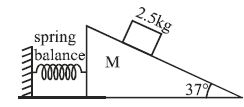
Find the reading of spring balance as shown in figure. Assume that mass $M$ is in equilibrium. All surfaces are smooth ....... $N$