MCQ
The density of water at $4^\circ C$ is:
  • $1.0 \times 10^3 \mathrm{~kg} \mathrm{~m}^{-3}$
  • B
    $4 \times 10^2 \mathrm{~kg} \mathrm{~m}^{-3}$
  • C
    $6 \times 10^3 \mathrm{~kg} \mathrm{~m}^{-3}$Z
  • D
    $3.2 \times 10^3 \mathrm{~kg} \mathrm{~m}^{-3}$

Answer

Correct option: A.
$1.0 \times 10^3 \mathrm{~kg} \mathrm{~m}^{-3}$
The density of water at $4^\circ C (277K)$ is $1.0 \times 10^3 \mathrm{~kg} \mathrm{~m}^{-3}$.

Need a full question paper?

Generate a complete, print-ready paper with questions like this in minutes — across 16+ boards, with answer keys.
Start Generating Free

Similar questions

A wheel is subjected to uniform angular acceleration about its axis. Initially its angular velocity is zero. In the first $2$ sec, it rotates through an angle ${\theta _1}$. In the next $2$ sec, it rotates through an additional angle ${\theta _2}$. The ratio of ${\theta _2}\over{\theta _1}$ is
The frequency of a sound wave is $n$ and its velocity is $v$. If the frequency is increased to $4n,$ the velocity of the wave will be
A man can swim with velocity $v$ relative to water. He has to cross a river of width $d $ flowing with a velocity $u (u > v)$. The distance through which he is carried down stream by the river is $x$. Which of the following statement is correct
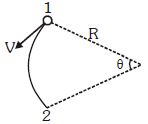
A ring of mass $m$ moves from point $1$ to point $2$ along a smooth rigid horizontal wire with a constant speed $v$. The average force acting the ring over the time of its motion from $1$ to $2$ is
The ratio of rotational and translatory kinetic energies of a sphere is                
Which of the following quantities does not depend upon the orbital radius of the satellite
Two uniform strings $A$ and $B$ made of steel are made to vibrate under the same tension. if the first overtone of $ A$ is equal to the second overtone of $B$ and if the radius of $A$ is twice that of $B,$ the ratio of the lengths of the strings is
The density of a material is $CGS$ system of units is $4\,g/cm^3$. In a system of units in which unit of length is $10\,cm$ and unit of mass is $100\,g$, the value of density of material will be
A steel rail of length $5\,m$ and area of cross-section $40\,cm^2$ is prevented from expanding along its length while the temperature rises by $10\,^oC$. If coefficient of linear expansion and Young's modulus of steel are $1.2\times10^{-5}\, K^{-1}$ and $2\times10^{11}\, Nm^{-2}$ respectively, the force developed in the rail is approximately
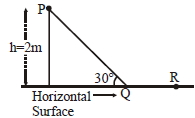
A point particle of mass, moves along the uniformly rough track $PQR$ as shown in the figure. The coefficient of friction, between the particle and the rough track equals $\mu$. The particle is released, from rest, from the point $P$ and it comes to rest at a point $R$. The energies, lost by the ball, over the parts, $PQ$ and $PR$, of the track, are equal to each other, and no energy is lost when particle changes direction from $PQ$ to $QR$. The values of the coefficient of friction $\mu$ and the distance $x(=QR)$ are, respecitvely close to