MCQ
The derivative of $F[f\{ \phi (x)\} ]$ is
  • A
    $F'\,[f\,\{ \phi  \,(x)\} ]$
  • B
    $F\,[f\,\{ \phi \,(x)\} \,]\,f'\{ \phi (x)\} $
  • C
    $F'[f\,\{ \phi \,(x)\} ]\,f'\{ \phi (x)\} $
  • $F'\,[f\,\{ \phi \,(x)\} ]\,f'\{ \phi (x)\} \,\phi  '\,(x)$

Answer

Correct option: D.
$F'\,[f\,\{ \phi \,(x)\} ]\,f'\{ \phi (x)\} \,\phi  '\,(x)$
d
(d) $y' = F'[f\{ \phi (x)\} ]\,f'\,\{ \phi (x)\} \,\phi '(x)$.

Need a full question paper?

Generate a complete, print-ready paper with questions like this in minutes — across 16+ boards, with answer keys.
Start Generating Free

Similar questions

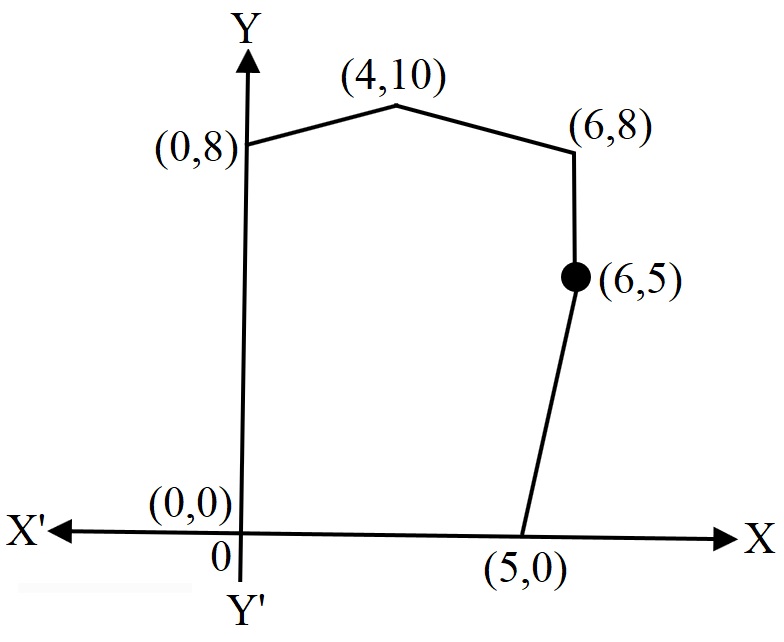
The feasible solution for a LPP is shown in the following figure. Let Z = 3x - 4y be the objective function.

Minimum of Z occurs at:

  1. (0, 0)
  2. (0, 8)
  3. (5, 0)
  4. (4, 10)
If $\vec{\text{a}},\vec{\text{b}},\vec{\text{c}}$ are non-coplanar vectors, then $\frac{\vec{\text{a}}.\big(\vec{\text{b}}\times\vec{\text{c}}\big)}{\big(\vec{\text{c}}\times\vec{\text{a}}\big).\vec{\text{b}}}+\frac{\vec{\text{b}}.\big(\vec{\text{a}}\times\vec{\text{c}}\big)}{\vec{\text{c}}.\big(\vec{\text{a}}\times\vec{\text{b}}\big)}$ is equal to:
  1. 0
  2. 2
  3. 1
  4. None of these
The differential equation representing the family of ellipse having foci either on the $x-$ axis or on the $y-$ axis centre at the origin and passing through the point  $(0,3)$ is
A line $AB$ in three-dimensional space makes angles $45^o $ and  $120^o $ with the positive $x-$ axis and the positive $y-$ axis respectively. If $AB$ makes an acute angle $\theta$ with the positive $z-$axis, then $\theta$ equals
If the feasible region for a solution of linear inequations is bounded, it is called as:
  1. Concave Polygon
  2. Finite Region
  3. Convex Polygon
  4. None of the above
If a particle moves such that the displacement is proportional to the square of the velocity acquired, then its acceleration is
If $a, b$  and  $c$  be three non-zero vectors, no two of which are collinear. If the vector $a + 2b$ is collinear with $ c$  and $b + 3c$ is collinear with a, then ($\lambda $ being some non-zero scalar) $a + 2b + 6c$ is equal to
If ${I_1} = \int\limits_1^{\sin \theta } {\frac{x}{{1 + x^2}}} \,dx$ and ${I_2} = \int\limits_1^{\cos ec\theta } {\frac{{dx}}{{x\left( {{x^2} + 1} \right)}}}$; then the value of $\left| {\begin{array}{*{20}{c}}
  {{I_1}}&{I_1^2}&{{I_2}} \\ 
  {{e^{{I_1} + {I_2}}}}&{I_2^2}&{ - 1} \\ 
  1&{I_1^2 + I_2^2}&{ - 1} 
\end{array}} \right|$ is
If $i + 2j + 3k$ and $3i - 2j + k$ represents the adjacent sides of a parallelogram, then the area of this parallelogram is
Let $g\left( x \right) = 2f\left( {\frac{x}{2}} \right) + f\left( {2 - x} \right)$ and $f'\left( x \right) < 0\ \forall x \in \left( {0,2} \right)$. Then $g(x)$ increases in