Question
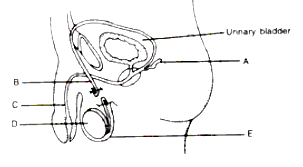
The diagram shown below represents a surgical sterilization method in males. Study the same and answer the questions that follow:
(i) Name the parts marked A, B, C, D and E.
(ii) Give the name of the surgical method represented in the diagram.
(iii) Which part is ligated or cut?
(iv) Name the corresponding surgical method conducted on females.
(v) Name the part which is ligated in females and why?
Answer

(i) A → Seminal vesicle
B → Vas deferens
C → Urethra
D → Testis
E → Scrotum
(ii) Vasectomy
(iii) Vas deferens
(iv) Tubectomy
(v) The part which is ligated in females is Fallopian tube. This is done to prevent the flow of eggs into the oviduct and its fusion with the sperm.

Need a full question paper?

Generate a complete, print-ready paper with questions like this in minutes — across 16+ boards, with answer keys.

Start Generating Free

Similar questions

What does the term “double circulation” mean?
Draw a labelled diagram to show the metaphase stage of mitosis in an animal cell having ‘6’ chromosomes.
Complete the following table by writing the name of the structure or the function of the given structure:
Structure Function
1Corpus luteum1……………
2…………….2Produces male gametes in mass
3Placental disc3……………………..
4. …………….4Increases the force in uterine contractions during child birth
5Umbilical cord5………………….
6Fallopian tube6…………………
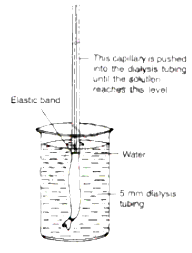
The apparatus arranged alongside signifies an important process.
(i) Name the process.
(ii) Where does this process occur in plants?
(iii) What solution is placed inside the dialysis tubing?
(iv) What happens to the level of the solution in the capillary tube?
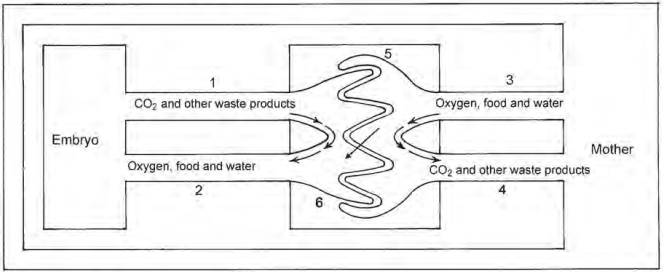
The diagram shows the structure of part of a human placenta.
(i) Name the structures labelled $1-6$.
(ii) What substances diffuse into the placenta and what diffuse out of it?
(iii) What are the functions of placenta?

Image
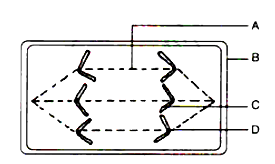
The diagram given alongside represents a stage in cell division.
Study the same and answer the questions that follow:

(i) Identify the stage of cell division.
(ii) Name the parts labeled A,B,C and D.
(iii) What is the unique feature observed in this stage?
(iv) Where does this type of cell division usually occur?
(v) How many daughter cells are formed from this type of cell division?
(vi) Is the dividing cell shown a plant or an animal cell?
Give a reason to support your answer.
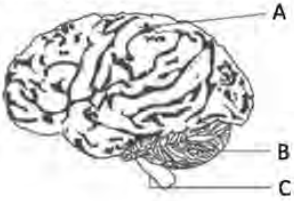
The diagram given below shows a section of the human brain.

Image

(i) Name the parts labelled $A, B$ and $C$.
(ii) Give the main function of each of the parts, $A, B$ and $C$.
(iii) Name the three protective membranes covering the brain.
Name the stimulus which causes the following movements in plants.
phototropism,thigmotropism, hydrotropism and geotropism
Explain the Term: Reflex action
Photosynthesis in green plants is directly and indirectly dependent on so many plant structures.
Explain briefly the role of the following structures in this process is Phloem tissue in the leaf veins.