Question
The diagram shows a rectangular coil ABCD, suspended freely between the concave pole pieces of a permanent horseshoe magnet, such that the plane of the coil is parallel to the magnetic field.
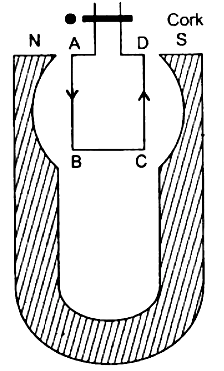
(i) State your observation, when current is switched on.
(ii) Give an explanation for your observation in (i).
(iii) State the rule, which will help you to find the motion of rotation of coil.
(iv) In which position will the coil ultimately come to rest?
(v) State four ways of increasing the magnitude of force acting on the coil.
Answer

(i) The coil ABCD will turn. The arm AB of the coil will move out of the plane of paper and arm CD into the plane of paper. Thus, coil will turn in anticlockwise direction.(ii) A magnetic field is set up by the coil due to the passage of electric current. The magnetic field of the coil is at right angles to the magnetic field of permanent magnet. Thus, a magnetic couple acts, which turns the coil.
(iii) Fleming’s left rule: It states: Stretch the thumb, the forefinger and the middle finger of left hand, such that forefinger points in the direction of magnetic field; middle finger points in the direction of current. Then, the thumb points in the direction of motion of conductor.
(iv) The coil will come to rest at right angles to the direction of magnetic field.
(v)
(a) By increasing the number of turns in coil.
(b) By increasing the area of cross-section of coil.
(c) By placing laminated soft iron core within the coil.
(d) By increasing the magnitude of the current coil.

Need a full question paper?

Generate a complete, print-ready paper with questions like this in minutes — across 16+ boards, with answer keys.

Start Generating Free

Similar questions

State one advantage of using a.c. over d.c.
What should be the characteristic of a source of energy?
What is the difference between renewable and non-renewable resources?
An electric bulb is rated 250 W, 230 V.

(i) the energy consumed in one hour, and

(ii) the time in which the bulb will consume 1.0 kWh energy when connected to 230 V mains.

The refractive index of glass os 1.5 . From a point $P$ inside a glass block, draw rays $PA , PB$ and $PC$ incident on the glass air surface at an angle of incidence $30^{\circ}, 42^{\circ}$ and $60^{\circ}$ respectively.
(a) In the diagram show the approximate direction of these rays as they emerge out of the block.
(b) What is the angle of refraction for the ray PB?
$\left(\right.$ Take $\sin 42^{\circ}=\frac{2}{3}$
Some hot water was added to three times its mass of cold water at 10°C and the resulting temperature was found to be 20°C. What was the temperature of the hot water?
The rearview mirror of a motorbike starts vibrating violently at some particular speed of the motorbike. What is the name of the phenomenon taking place? Why does the happen?
Draw a diagram of a single fixed pulley and obtain expressions for its:
(i) Mechanical advantage,
(ii) Velocity ratio, and
(iii) Efficiency, in the ideal case.
Explain the use of radioactive in the field of medicine, agriculture and industry.