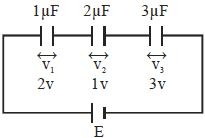
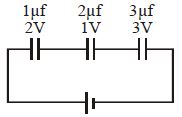
The diagram shows three capacitors with their capacitances and with breakdown voltages. What should be the maximum value of external $emf$ of source such that no capacitor breaks down
Experience the future of education. Simply download our apps or reach out to us for more information. Let's shape the future of learning together!No signup needed.*
A capacitor having capacitance $C$ is charged to a voltage $V$. It is then removed and connected in parallel with another identical capacitor which is uncharged. The new charge on each capacitor is now
In the circuit below $C_1=20 \,\mu F , C_2=40 \,\mu F$ and $C_3=50 \,\mu F$. If no capacitor can sustain more than $50 \,V$, then maximum potential difference between $X$ and $Y$ is .......... $V$
Consider the configuration of a system of four charges each of value $+q$ . The work done by external agent in changing the configuration of the system from figure $(1)$ to figure $(2)$ is
Three charged particles having charges $q,-2 q$ and $q$ are placed in a line at points $(-a, 0),(0,0)$ and $(a, 0)$ respectively. The expression for electric potential at $P(r, 0)$ for $r \gg a$ is ...............
A proton and an anti-proton come close to each other in vacuum such that the distance between them is $10 \,cm$. Consider the potential energy to be zero at infinity. The velocity at this distance will be ........... $\,m / s$
All the six capacitors shown in the circuit are identical. Each can withstand maximum $200\, volt$ between its terminals. The maximum voltage that can be applied safely between $A$ and $B$ is.....$V$
The capacity of a parallel plate condenser is $10\,\mu \,F$, when the distance between its plates is $8 \,cm$. If the distance between the plates is reduced to $4\, cm$, then the capacity of this parallel plate condenser will be.........$\mu \,F$