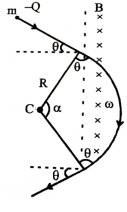
A particle with charge $-Q$ and mass m enters a magnetic field of magnitude $B,$ existing only to the right of the boundary $YZ$. The direction of the motion of the $m$ particle is perpendicular to the direction of $B.$ Let $T = 2\pi\frac{m}{{QB}}$ . The time spent by the particle in the field will be
Advanced


Download our appand get started for free
Experience the future of education. Simply download our apps or reach out to us for more information. Let's shape the future of learning together!No signup needed.*
Similar Questions
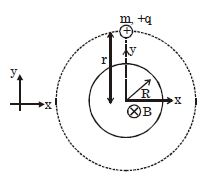
- 1Circular region of radius $R$ has uniform magnetic field $B = {B_0} + {B_0}t\left( { - \hat k} \right).\,At\,\,t\, = 0\,$ acceleration of charged particleView Solution
- 2A uniform beam of positively charged particles is moving with a constant velocity parallel to another beam of negatively charged particles moving with the same velocity in opposite direction separated by a distance $d.$ The variation of magnetic field $B$ along a perpendicular line draw between the two beams is best represented byView Solution
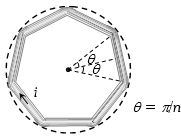
- 3In the following figure a wire bent in the form of a regular polygon of $n$ sides is inscribed in a circle of radius $a$. Net magnetic field at centre will beView Solution
- 4A circular loop has a radius of $5\, cm$ and it is carrying a current of $0.1\, amp$. Its magnetic moment isView Solution
- 5An electron with energy $0.1\,ke\,V$ moves at right angle to the earth's magnetic field of $1 \times 10^{-4}\,Wbm ^{-2}$. The frequency of revolution of the electron will be. (Take mass of electron $=9.0 \times 10^{-31}\,kg$ )View Solution
- 6.......$A$ should be the current in a circular coil of radius $5\,cm$ to annul ${B_H} = 5 \times {10^{ - 5}}\,T$View Solution
- 7Two particles $A$ and $B$ having equal charges $+6\,C$, after being accelerated through the same potential difference, enter in a region of uniform magnetic field and describe circular paths of radii $2\,cm$ and $3\,cm$ respectively. The ratio of mass of $A$ to that of $B$ isView Solution
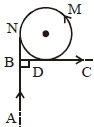
- 8A very long wire $ABDMNDC$ is shown in figure carrying current $I. AB$ and $BC$ parts are straight, long and at right angle. At $D$ wire forms a circular turn $DMND$ of radius $R. AB.$ $\mathrm{BC}$ parts are tangential to circular turn at $\mathrm{N}$ and $D$. Magnetic field at the centre of circle isView Solution
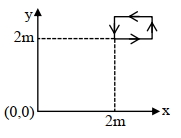
- 9The magnetic field existing in a region is given by $\overrightarrow{\mathrm{B}}=0.2(1+2 \mathrm{x}) \hat{\mathrm{k} T}$. A square loop of edge $50 \mathrm{~cm}$ carrying $0.5 \mathrm{~A}$ current is placed in $x-y$ plane with its edges parallel to the $x-y$ axes, as shown in figure. The magnitude of the net magnetic force experienced by the loop is___________. $\mathrm{mN}$.View Solution
- 10In toroid magnetic field on axis will be the radius $=0.5\, cm ,$ current $=1.5\, A ,$ turns $=250,$ permeability $=700$ (in Tesla)View Solution