The diameter of a brass rod is 4 mm and Young's modulus of brass is $9 \times {10^{10}}\,N/{m^2}$. The force required to stretch by $0.1\%$ of its length is
Medium
Download our app for free and get started
(a)$F = \frac{{YAl}}{L} = \frac{{9 \times {{10}^{10}} \times \pi \times 4 \times {{10}^{ - 6}} \times 0.1}}{{100}} = 360\;\pi \;N$

Download our appand get started for free
Experience the future of education. Simply download our apps or reach out to us for more information. Let's shape the future of learning together!No signup needed.*
Similar Questions
- 1An Indian rubber cord $L$ metre long and area of cross-section $A$ $metr{e^2}$ is suspended vertically. Density of rubber is $D$ $kg/metr{e^3}$ and Young's modulus of rubber is $E$ $newton/metr{e^2}$. If the wire extends by $l$ metre under its own weight, then extension $l$ isView Solution
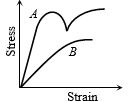
- 2The diagram shows stress v/s strain curve for the materials $A$ and $B$. From the curves we infer thatView Solution
- 3View SolutionIf the length of a wire is made double and radius is halved of its respective values. Then, the Young's modules of the material of the wire will :
- 4In $CGS$ system, the Young's modulus of a steel wire is $2 \times {10^{12}}$. To double the length of a wire of unit cross-section area, the force required isView Solution
- 5The maximum elongation of a steel wire of $1 \mathrm{~m}$ length if the elastic limit of steel and its Young's modulus, respectively, are $8 \times 10^8 \mathrm{~N} \mathrm{~m}^{-2}$ and $2 \times 10^{11} \mathrm{~N} \mathrm{~m}^{-2}$, is:View Solution
- 6View SolutionThe modulus of elasticity is dimensionally equivalent to
- 7A uniformly tapering conical wire is made from a material of Young's modulus $Y$ and has a normal, unextended length $L.$ The radii, at the upper and lower ends of this conical wire, have values $R$ and $3R,$ respectively. The upper end of the wire is fixed to a rigid support and a mass $M$ is suspended from its lower end. The equilibrium extended length, of this wire, would equalView Solution
- 8If Poission's ratio $\sigma $ is $ - \frac{1}{2}$ for a material, then the material isView Solution
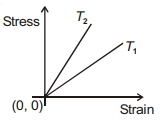
- 9View SolutionFigure shows graph between stress and strain for a uniform wire at two different femperatures. Then
- 10View SolutionYoung's modulus of elasticity of material depends upon