MCQ
The difference between threshold wavelengths for two metal surfaces $A$ and $B$ having work function $\phi_A=9\,eV$ and $\phi_{ B }=4.5\,eV$ in $nm$ is:(Given, $hc =1242\,eV\,nm$)
  • A
    $264$
  • $138$
  • C
    $276$
  • D
    $540$

Answer

Correct option: B.
$138$
b
$\lambda_{ A }=\left(\frac{1242}{9}\right)=138\,nm$

$\lambda_{ B }=\left(\frac{1242}{4.5}\right)=276\,nm$

$\lambda_{ B }-\lambda_{ A }=138\,nm$

Need a full question paper?

Generate a complete, print-ready paper with questions like this in minutes — across 16+ boards, with answer keys.
Start Generating Free

Similar questions

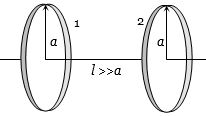
What is the mutual inductance of a two-loop system as shown with centre separation l
The de-Broglie wavelength of a particle accelerated with 150 volt potential is $10^{-10}$ m. If it is accelerated by 600 volts p.d., its wavelength will be
Unpolarised light is incident from air on a plane surface of a material of refractive index $\mu .$ At a particular angle of incidence $i,$ it is found that the reflected and refracted rays are perpendicular to each other. Which of the following options is correct for this situation? 
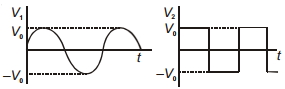
The sinusoidal potential difference $V_1$ shown in figure applied across a resistor $R$ produces heat at a rate $W$. What is the rate of heat dissipation when the square wave potential difference $V_2$ as shown in figure is applied across the resistor?
The desirable properties for making permanent magnets are:
The magnetic field at a distance $r$ from a long wire carrying current $i$ is $0.4\, Tesla$. The magnetic field at a distance $2r$ is......$Tesla$
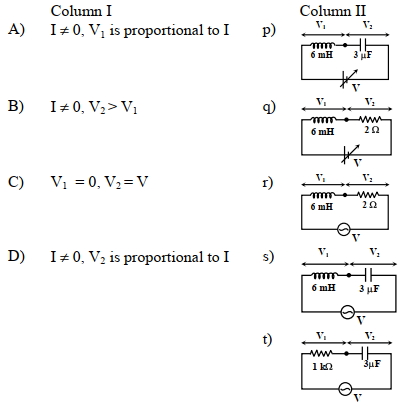
You are given many resistances, capacitors and inductors. These are connected to a variable $DC$ voltage source (the first two circuits) or an $\mathrm{AC}$ voltage source of $50 \mathrm{~Hz}$ frequency (the next three circuits) in different ways as shown in Column $II$. When a current $I$ (steady state for $DC$ or rms for $AC$) flows through the circuit, the corresponding voltage $\mathrm{V}_1$ and $\mathrm{V}_2$. (indicated in circuits) are related as shown in Column $\mathrm{I}$. Match the two

$Image$

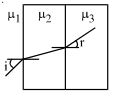
In the figure shown $\frac{{\sin i}}{{\sin r}}$ is equal to :
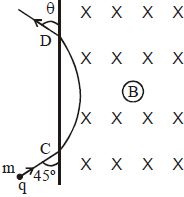
A particle of mass $m = 1.67 \times 10^{-27}\, kg$ and charge $q = 1.6 \times 10^{-19} \, C$ enters a region of uniform magnetic field of strength $1$ $tesla$ along the direction shown in the figure. The speed of the particle is $10^7\, m/s.$ The magnetic field is directed along the inward normal to the plane of the paper. The particle enters the field at $C$ and leaves at $D.$ Then the angle $\theta$ must be :-.........$^o$
Least doped region in a transistor