MCQ
The differential equation $\cot y\,\,dx = x\,\,dy$ has a solution of the form
  • A
    $y = \cos x$
  • $x = c\sec y$
  • C
    $x = \sin y$
  • D
    $y = \sin x$

Answer

Correct option: B.
$x = c\sec y$
b
(b) $\cot y.dx = x.dy$ ==> $\frac{{dx}}{x} = \frac{{dy}}{{\cot y}}$ ==> $\frac{{dx}}{x} = \tan y.dy$

Integrating both sides,

$\log x = \log \sec y + \log c$ ==> $x = c\sec y$.

Need a full question paper?

Generate a complete, print-ready paper with questions like this in minutes — across 16+ boards, with answer keys.

Start Generating Free

Similar questions

The corner points of the feasible region determined by the system of linear inequalities are (0, 0), (4, 0), (2, 4) and (0, 5). If the maximum value of z = ax + by, where a, b > 0 occurs at both (2, 4) and (4, 0), then:
Let $M =\left[\begin{array}{lll}0 & 1 & a \\ 1 & 2 & 3 \\ 3 & b & 1\end{array}\right]$ and adj $M =\left[\begin{array}{ccc}-1 & 1 & -1 \\ 8 & -6 & 2 \\ -5 & 3 & -1\end{array}\right]$ where $a$ and $b$ are real numbers. Which of the following options is/are correct?

$(1)$ $a+b=3$

$(2)$ $\operatorname{det}\left(\operatorname{adj} M ^2\right)=81$

$(3)$ $(\operatorname{adj} M)^{-1}+\operatorname{adj} M^{-1}=-M$

$(4)$ If $M \left[\begin{array}{l}\alpha \\ \beta \\ \gamma\end{array}\right]=\left[\begin{array}{l}1 \\ 2 \\ 3\end{array}\right]$, then $\alpha-\beta+\gamma=3$

If $P(A)=\frac{1}{2}, P(B)=0,$ then $P(A | B)$ is
If for $p \neq q \neq 0$, then function,$f(x)=\frac{\sqrt[7]{p(729+x)}-3}{\sqrt[3]{729+q x}-9}$is continuous at $x=0$, then
If $\text{y}=\tan^{-1}\Big\{\frac{\log(\frac{\text{e}}{\text{x}})^2}{\log(\frac{\text{e}}{\text{x}})^2}\Big\}+\tan^{-1}\Big(\frac{3-2\log,\text{x}}{1-6\log,\text{x}}\Big)$ then $\frac{\text{d}^2\text{y}}{\text{dx}^2}=$
If f : $R$ $\rightarrow$  $R$ such that $f(x)$ = $5x - 3cosx - 4sinx$,then function $f(x)$ is
If $y = \sqrt {x + \sqrt {x + \sqrt {x + ........{\rm{to\,\,}}} } } \infty \,,\,{\rm{then}}{{dy} \over {dx}} = $
Let $(x, y, z)$ be points with integer coordinates satisfying the system of homogeneous equations:

$3 x-y-z $$ =0 $, $-3 x+z $$ =0 $, $-3 x+2 y+z $$ =0 .$

Then the number of such points for which $x^2+y^2+z^2 \leq 100$ is
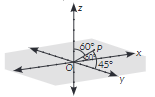
A line $\overrightarrow{O P}$ in space, represented by the figure below; has a magnitude of $2 \sqrt{2}$ units.
Image
Which of these are the direction ratios of $\overrightarrow{O P}$ ?
Choose the correct answer from the given four options: The function $f(x) = 2x^3 - 3x^2 - 12x + 4,$ has: