MCQ
The diffusion current in a $p-n$ junction is:
  • A
    From the n-side to the $p-$side.
  • From the $p-$side to the $n-$side.
  • C
    From the $n-$side to the p-side if the junction is forward$-$biased and in the opposite direction if it is reverse$-$biased.
  • D
    From the $p-$side to the $n-$side if the junction is forward$-$biased and in the opposite direction if it is reverse$-$biased.

Answer

Correct option: B.
From the $p-$side to the $n-$side.

When a $p‒n$ junction is formed then because of the difference in the concentration of charge carriers in the two regions, electrons from the $n$ region move to the $p$ region and holes from the $p$ region move to the $n$ region. Since the direction of the current is always opposite to the motion of electron, the direction of the current is from the $p$ side to the n side.
Similarly, when the junction is forward biassed, the positive terminal of the battery is connected to the pside of the $p‒n$ junction and the negative terminal of the battery is connected to the n side of the $p‒n$junction. As a result, electrons in the n side of the $p‒n$ junction are repelled by the negative terminal of the battery and they move to the $p$ side, where the positive terminal of the battery attracts them. Similarly, holes from the $p$ side of the $p‒n$ junction are repelled by the positive terminal of the battery and they move to the $n$ side, where the negative terminal of the battery attracts them. Thus, they give diffusion current from the $p$ side to the $n$ side across the $p‒n$ junction.
In reverse biassing, there is no flow of majority carriers across the junction; hence, there is not diffusion current. Here, the flow of majority carriers is opposed by the applied voltage.
Need a full question paper?

Generate a complete, print-ready paper with questions like this in minutes — across 16+ boards, with answer keys.

Start Generating Free

Similar questions

If a current of $3.0$ $amperes$ flowing in the primary coil is reduced to zero in $0.001$ $second,$ then the induced $e.m.f$ in the secondary coil is $15000$ $volts$. The mutual inductance between the two coils is....$henry$
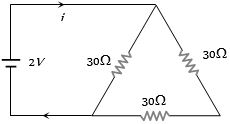
The current in the adjoining circuit will be
The momentum of an electron revolving in $n ^{\text {th }}$ orbit is given by: (Symbols have their usual meanings)
Two different coils have self-inductance $\mathrm{L}_1=8 \mathrm{mH} , \mathrm{L}_2=2 \mathrm{mH}$. The current in one coil is increased at a constant rate. The current in the second coil is also increased at the same rate. At a certain instant of time, the power given to the two coils is the same. At that time the current, the induced voltage and the energy stored in the first coil are $i_1,v_1$ and $W_1$ respectively. Corresponding values for the second coil at the same instant are $i_2,v_1$ and $W_2$ respectively. Then
What is the energy of photon whose wavelength is $6840\,\mathop A\limits^o $ ?......$eV$
$2\,\mu F$ capacitance has potential difference across its two terminals $200\;volts$. It is disconnected with battery and then another uncharged capacitance is connected in parallel to it, then $P.D.$ becomes $20\;volts$. Then the capacity of another capacitance will be.......$\mu F$
Two opposite and equal charges $4 \times {10^{ - 8}}\,coulomb$ when placed $2 \times {10^{ - 2}}\,cm$ away, form a dipole. If this dipole is placed in an external electric field $4 \times {10^8}\,newton/coulomb$, the value of maximum torque and the work done in rotating it through $180^\circ $ will be
Sixty-four drops are jointed together to form a bigger drop. If each small drop has a capacitance C, a potential V, and a charge q, then the capacitance of the bigger drop will be
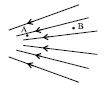
Which of the following is true for the figure showing electric lines of force? ($E$ is electrical field, $V$ is potential)
A nucleus of mass $M + \Delta m$ is at rest and decays into two  daughter nuclei of equal mass $\frac{M}{2}$ each. Speed of light is $c.$

The speed of daughter nuclei is