MCQ
The dimensional formula for the physical quantityis $\frac{{{E^2}{\mu _0}{\varepsilon _0}}}{{{B^2}}}$ ($E =$ electric field and $B =$ magnetic field)
  • $L^0M^0T^0$
  • B
    $L^1M^0T^{-1}$
  • C
    $L^{-1}M^0T^1$
  • D
    $L^{1/2}M^0T^{-1/2}$

Answer

Correct option: A.
$L^0M^0T^0$
a
We know,

$\mu_0 \varepsilon_0=\frac{1}{ c ^2}$

$\frac{E}{B}=c$

$\frac{ E ^2 \mu_0 \varepsilon_0}{ B ^2}=1$

Dimension of $1=\left[ M ^0 L ^0 T ^0\right]$

Need a full question paper?

Generate a complete, print-ready paper with questions like this in minutes — across 16+ boards, with answer keys.
Start Generating Free

Similar questions

The focal length of the objective and eye lenses of a microscope are $1.6\,cm$ and $2.5\, cm$ respectively. The distance between the two lenses is $21.7\,cm$. If the final image is formed at infinity, what is the linear magnification ?
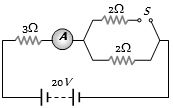
In the circuit shown, the reading of ammeter when switch $S$ is open and when switch $S$ is closed respectively are
The fact that electric charges are integral multiples of the fundamental electronic charge was proved experimentally by
A charged particle is suspended in equilibrium in a uniform vertical electric field of intensity 20000 V/m. If mass of the particle is $9.6 \times10^{-16} $kg ,the charge on it and excess number of electrons on the particle are respectively ($g=10m/s^2$)
Radioactive nuclei $P$ and $Q$ disintegrate into $R$ with half lives 1 month and 2 months respectively. At time $t=$ 0 , number of nuclei of each $P$ and $Q$ is $x$. Time at which rate of disintegration of $P$ and $Q$ are equal, number of nuclei of $R$ is ........ $x$
The focal lengths of objective lens and eye lens of a Galilean telescope are respectively $30\, cm$ and $3.0\, cm$. telescope produces virtual, erect image of an object situated far away from it at least distance of distinct vision from the eye lens. In this condition, the magnifying power of the Galilean telescope should be
Match List $- I$ (Experiment performed) with List $-II$ (Phenomena discovered/associated) and select the correct option from the options given the lists
List $- I$ List $- II$
$(1)$ Davisson and Genner $(i)$ Wave nature of electrons
$(2)$ Millikan's oil drop experiment $(ii)$ Charge of an electron
$(3)$ Rutherford experiment $(iii)$ Quantisation of energy levels
$(4)$ Franck-Hertz experiment $(iv)$ Existence of nucleus
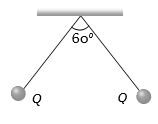
Two small spherical balls each carrying a charge $Q = 10\,\mu C$ ($10$ micro-coulomb) are suspended by two insulating threads of equal lengths $1\,m$ each, from a point fixed in the ceiling. It is found that in equilibrium threads are separated by an angle ${60^o}$ between them, as shown in the figure. What is the tension in the threads......$N$ (Given: $\frac{1}{{(4\pi {\varepsilon _0})}} = 9 \times {10^9}\,Nm/{C^2}$)
Two charges are at a distance $‘d’$ apart. If a copper plate (conducting medium) of thickness $\frac{d}{2}$ is placed between them, the effective force will be
A sinusoidal voltage of peak value $250\, V$ is applied to a series $LCR$ circuit, in which $R =8 \Omega, L =24\, mH$ and $C =60 \mu F$. The value of power dissipated at resonant condition is $'x'\, kW$. The value of $x$ to the nearest integer is .............