MCQ
The dimensional formula for thermal resistance is
  • $M^{-1} L^{-2} T^3 \theta$
  • B
    $M^{-1}L^{-2}T^{-3} \theta$
  • C
    $ML^{2} T^{-2} \theta$
  • D
    $ML^{2} T^2 \theta^{-1}$

Answer

Correct option: A.
$M^{-1} L^{-2} T^3 \theta$
a
$\frac{{{\text{dH}}}}{{{\text{dt}}}} = \frac{{{T_1} - {T_2}}}{R}\,\,\,\,\,\,\,\frac{{M{L^2}{T^{ - 2}}}}{T} = \frac{\theta }{R}$

Need a full question paper?

Generate a complete, print-ready paper with questions like this in minutes — across 16+ boards, with answer keys.
Start Generating Free

Similar questions

Find the magnitude of constant acceleration (in $m/ s^2$) needed to allow a car to accelerate in a straight line from a speed of zero to a speed of $30\ m/ s$ in $5\ s:$
When temperature of water is raised from $O\ 'C$ to $4^\circ C,$ it:
A point particle is held on the axis of a ring of mass $m$ and radius $r$ at a distance $r$ from its centre $C$. When released, it reaches $C$ under the gravitational attraction of the ring. Its speed at $C$ will be
When a ceiling fan is switched off, its angular velocity falls to half while it makes $36$ $rotations.$ How many more rotations will it make before coming to rest (Assume uniform angular retardation)
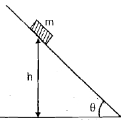
A block of mass $m$ is sliding down an inclined plane with constant speed.At a certain instant $t_0$, its height above the ground is $h$. The coefficient of kinetic friction between the block and the plane is $\mu$. If the block reaches the ground at a later instant $t_g$, then the energy dissipated by friction in the time interval $\left(t_g-t_0\right)$ is
A thin $1 \,m$ long rod has a radius of $5\, mm$. A force of $50\,\pi kN$ is applied at one end to determine its Young's modulus. Assume that the force is exactly known. If the least count in the measurement of all lengths is $0.01\, mm$, which of the following statements is false ?
A boy is rolling a $0.5\, kg$ ball on the frictionless floor with the speed of $20\, ms ^{-1}$. The ball gets deflected by an obstacle on the way. After deflection it moves with $5 \%$ of its initial kinetic energy. What is the speed of the ball now ? (in $ms ^{-1}$)
A Carnot engine take $5000 \,k\,cal$ of heat from a reservoir at $727\,^{\circ}C$ and gives heat to a $\operatorname{sink}$ at $127\,^{\circ}C$. The work done by the engine is $.......... \times 10^{6}\,J$
Abody is moving uni-directionally under the influence of a source of constant power. Its displacement in time $t$ is proportional to
The energy spectrum of a black body exhibits a maximum around a wavelength ${\lambda _o}.$ The temperature of the black body is now changed such that the energy is maximum around a wavelength $\frac{{3{\lambda _o}}}{4}$.The power radiated by the black body will now increase by a factor of