MCQ
When temperature of water is raised from $O\ 'C$ to $4^\circ C,$ it:
  • A
    Expands.
  • Contracts.
  • C
    Expands upto $2^\circ C$ and then contracts upto $4^\circ C.$
  • D
    Contracts upto $2^\circ C$ and then expands upto $4^\circ C.$

Answer

Correct option: B.
Contracts.

Need a full question paper?

Generate a complete, print-ready paper with questions like this in minutes — across 16+ boards, with answer keys.
Start Generating Free

Similar questions

When two waves of almost equal frequency $n_1$ and $n_2$ are produced simultaneously, then the time interval between successive maxima is:
The equation of state for a gas is given by $PV = nRT + \alpha V$, where $n$ is the number of moles and $\alpha $ is a positive constant. The initial temperature and pressure of one mole of the gas contained in a cylinder are $T_o$ and $P_o$ respectively. The work done by the gas when its temperature doubles isobarically will be
Alarge tank is filled with water to a height $H$.A small hole is made at the base of the tank. It takes $T_1$ time to decrease the height of water to $H/ \eta , (\eta > 1)$ and it takes $T_2$ time to take out the rest of water. If $T_1 = T_2$ , then the value of $\eta$ is :
When an object is in equilibrium state, then
Two pendulums of length $121\,cm$ and $100\,cm$ start vibrating in phase. At some instant, the two are at their mean position in the same phase. The minimum number of vibrations of the shorter pendulum after which the two are again in phase at the mean position is :
The number of significant figures in the amount $201,00,000$ is:
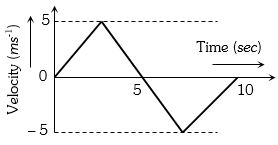
The $v- t$ plot of a moving object is shown in the figure. The average velocity of the object during the first $10$ seconds is...........$m/s$
Given below are two statements : one is labelled as Assertion $A$ and the other is labelled as Reason $R.$

Assertion $A :$ Moment of inertia of a circular disc of mass $'M'$ and radius $'R'$ about $X, Y$ axes (passing through its plane) and $Z-$axis which is perpendicular to its plane were found to be $I_{x}, I_{y}$ and ${I}_{z}$ respectively. The respective radii of gyration about all the three axes will be the same.

Reason $R$ : A rigid body making rotational motion has fixed mass and shape.

In the light of the above statements, choose the most appropriate answer from the options given below :

A metal rod $\mathrm{AB}$ of length $10 x$ has its one end $\mathrm{A}$ in ice at $0^{\circ} \mathrm{C}$ and the other end $\mathrm{B}$ in water at $100^{\circ} \mathrm{C}$. If a point $\mathrm{P}$ on the rod is maintained at $400^{\circ} \mathrm{C}$, then it is found that equal amounts of water and ice evaporate and melt per unit time. The latent heat of evaporation of water is $540 \ \mathrm{cal} / \mathrm{g}$ and latent heat of melting of ice is $80 \ \mathrm{cal} / \mathrm{g}$. If the point $\mathrm{P}$ is at a distance of $\lambda x$ from the ice end $\mathrm{A}$, find the value of $\lambda$.

[Neglect any heat loss to the surrounding.|

Consider the quantity $\frac{\text{MkT}}{\text{pV}}$ of an ideal gas where $M$ is the mass of the gas. It depends on the,