MCQ
The dimensions of electric flux are:
- A[M L-3 T-3 A-1].
- B[M L-3 T-3 A-1].
- C[M L3 T-3 A-1].
- DNone.
Generate a complete, print-ready paper with questions like this in minutes — across 16+ boards, with answer keys.
A bar magnet when placed at an angle of 30o to the direction of magnetic field induction of 5 × 10⁻² T, experiences a moment of couple 25 × 10–6 N-m. If the length of the magnet is 5 cm its pole strength is
|
(a) 2 × 10⁻² A-m |
(b) 5 × 10⁻² A-m |
(c) 2 A-m |
(d) 5 A-m |
The phenomenon of diffraction of light was discovered by
|
(a) Hygens |
(b) Newton |
(c) Fresnel |
(d) Grimaldi |
Angle of prism is A and its one surface is silvered. Light rays falling at an angle of incidence 2A on first surface return back through the same path after suffering reflection at second silvered surface. Refractive index of the material of prism is
|
(a) 2 sin A |
(b) 2 cos A |
(c) |
(d) tan A |
The radius of a nucleus of a mass number A is directly proportional to
|
(a) |
(b) A |
(c) |
(d) |
Two unlike charges of magnitude q are separated by a distance 2d. The potential at a point midway between them is
|
(a) Zero |
(b) |
(c) |
(d) |
Two bulbs X and Y having same voltage rating and of power 40 watt and 60 watt respectively are connected in series across a potential difference of 300 volt, then
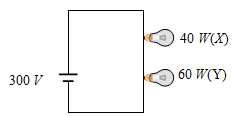
|
(a) X will glow brighter |
(b) Resistance of Y is greater than X |
|
(c) Heat produced in Y will be greater than X |
(d) Voltage drop in X will be greater than Y |

If an electron jumps from 1st orbital to 3rd orbital, then it will
|
(a) Absorb energy |
(b) Release energy |
|
(c) No gain of energy |
(d) None of these |
Which rays are not the portion of electromagnetic spectrum
|
(a) X-rays |
(b) Microwaves |
(c) a-rays |
(d) Radio waves |


