Question
The dimensions of impulse are equal to that of

Answer

(a) Momentum = $mv = [ML{T^{ - 1}}]$

Impulse = Force $ \times $ Time

= $[ML{T^{ - 2}}] \times [T] = [ML{T^{ - 1}}]$

Need a full question paper?

Generate a complete, print-ready paper with questions like this in minutes — across 16+ boards, with answer keys.
Start Generating Free

Similar questions

What should be the order of arrangement of de-Broglie wavelength of elelctron $\left(\lambda_{{e}}\right)$, an $\alpha-$ particle $\left(\lambda_{\alpha}\right)$ and proton $\left(\lambda_{p}\right)$ given that all have the same kinetic energy ?
A ray is reflected in turn by three plain mirrors mutually at right angles to each other. The angle between the incident and the reflected rays is......$^o$
A wave travelling along the $x-$axis is described by the equation $y\left( {x,t} \right) = 0.005cos\left( {\alpha x - \beta t} \right)$ If the wavelength and the time period of the wave are $0.08\ m$ and $2.0\ s$, respectively, then $\alpha$ and $\beta$ in appropriate units are
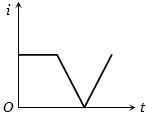
The current $i$ in an induction coil varies with time $t$ according to the graph shownin figure. Which of the following graphs shows the induced emf $(E$) in the coil with time
A stationary observer receives sound from two identical tuning forks, one of which approaches and the other one recedes with the same speed (much less than the speed of sound). The observer hears $2\; beats/sec$. The oscillation frequency of each tuning fork is $v_{0}=1400 \;\mathrm{Hz}$ and the velocity of sound in air is $350\; \mathrm{m} / \mathrm{s}$. The speed of each tuning fork is close to 
A system has basic dimensions as density $[D]$, velocity $[V]$ and area $[A]$. The dimensional representation of force in this system is 
When the light source is kept $20 cm$ away from a photo cell, stopping potential $0.6 V $ is obtained. When source is kept $40 cm$ away, the stopping potential will be .......... $V$
A particle is excuting a simple harmonic motion. Its maximum acceleration is $\alpha $ and maximum velocity is $\beta $. Then its frequency of vibration will be
The radiation corresponding to $3 \rightarrow 2$ transition of a hydrogen atom falls on a gold surface to generate photoelectrons. These electrons are passed through a magnetic field of $5 \times 10^{-4} \,{T}$. Assume that the radius of the largest circular path followed by these electrons is $7\, {mm}$, the work function of the metal is $.....\,{eV}$

(Mass of electron $=9.1 \times 10^{-31} \,{kg}$ )

The length of the two rods made up of the same metal and having the same area of cross-section are $0.6 m$ and $0.8 m$ respectively. The temperature between the ends of first rod is ${90^o}C$ and ${60^o}C$ and that for the other rod is $150^oC$ and ${110^o}C$. For which rod the rate of conduction will be greater