Question
A particle is excuting a simple harmonic motion. Its maximum acceleration is $\alpha $ and maximum velocity is $\beta $. Then its frequency of vibration will be

Answer

$a_{\max }=\alpha \Rightarrow \omega^{2} A=\alpha$           $...(1)$

$\mathrm{V}_{\max }=\beta \Rightarrow \omega \mathrm{A}=\beta$          $...(2)$

Dividing

$\omega=\frac{\alpha}{\beta} \Rightarrow n=\frac{\alpha}{2 \pi \beta}$

Need a full question paper?

Generate a complete, print-ready paper with questions like this in minutes — across 16+ boards, with answer keys.
Start Generating Free

Similar questions

A metal wire has mass $(0.4 \pm 0.002)\,g$, radius $(0.3 \pm 0.001)\,mm$ and length $(5 \pm 0.02) \,cm$. The maximum possible percentage error in the measurement of density will nearly be $.......\%$
When light is incident on a doubly refracting crystal, two refracted rays-ordinary ray ($O-$ray) and extra ordinary ray ($E-$ray) are produced. Then
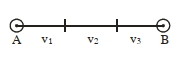
A car covers $A B$ distance with first one-third at velocity $v _{1} ms ^{-1}$, second one-third at $v _{2} ms ^{-1}$ and last one-third at $v _{3} ms ^{-1}$. If $v _{3}=3 v _{1}, v _{2}=2 v _{1}$ and $v _{1}=11\,ms ^{-1}$ then the average velocity of the car is________ $ms ^{-1} .$
The slope of plate characteristic of a vacuum tube diode for certain operating point on the curve is ${10^{ - 3}}\frac{{mA}}{V}$. The plate resistance of the diode and its nature respectively
The velocity of an electron in the second orbit of sodium atom (atomic number $= 11$) is $v$. The velocity of an electron in its fifth orbit will be
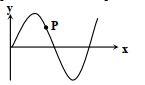
A transverse sinusoidal wave moves along a string in the positive $\mathrm{x}$-direction at a speed of $10 \mathrm{~cm} / \mathrm{s}$. The wavelength of the wave is $0.5 \mathrm{~m}$ and its amplitude is $10 \mathrm{~cm}$. At a particular time $t$, the snap -shot of the wave is shown in figure. The velocity of point $P$ when its displacement is $5 \mathrm{~cm}$ is Figure: $Image$
The magnifying power of a simple microscope is $6$. The focal length of its lens in metres will be, if least distance of distinct vision is $25\,cm$
According to the quantum theory, a photon of electromagnetic radiation of frequency $v$ has energy $E=h v$, where $h$ is known as Planck's constant. According to the theory of relativity, a particle of mass $m$ has equivalent energy $E=m c^2$, where $c$ is speed of light. Thus, a photon can be treated as a particle having effective mass $m=\frac{h v}{c^2}$ If a flash of light is sent horizontally in earth's gravitational field, then photons while travelling a horizontal distance $d$ would fall through a distance given by
If a vector $\overrightarrow P $ making angles $\alpha, \beta\  and\ \gamma$ respectively with the $X, Y$ and $Z$ axes respectively. Then ${\sin ^2}\alpha + {\sin ^2}\beta + {\sin ^2}\gamma = $
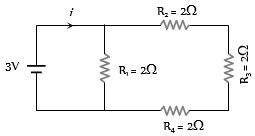
What is the current $(i)$ in the circuit as shown in figure ........... $A$