Question
The dimensions of polarisation are:

Answer

  1. [L-2 A T]

Need a full question paper?

Generate a complete, print-ready paper with questions like this in minutes — across 16+ boards, with answer keys.
Start Generating Free

Similar questions

The magnetic field due to a short magnet at a point on its axis at distance X cm from the middle point of the magnet is 200 Gauss. The magnetic field at a point on the neutral axis at a distance X cm from the middle of the magnet is(a) 100 Gauss(b) 400 Gauss(c) 50 Gauss(d) 200 Gauss
       
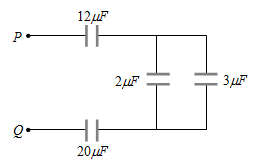
In the circuit diagram shown in the adjoining figure, the resultant capacitance between $P$ and $Q$ is
In the following reaction  $12^{\mathrm{Mg}^{24}}+2^{\mathrm{He}^4} \rightarrow 14^{\mathrm{Si}^{\mathrm{X}}}+0^{\mathrm{n}^1}, \mathrm{X}$ is
A charge $q$  is placed at the centre of the open end of cylindrical vessel. The flux of the electric field through the surface of the vessel is
The frequency of radio waves corresponding to a wavelength of $10m$ is:
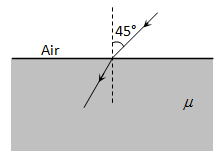
In the figure shown, for an angle of incidence $45^\circ ,$ at the top surface, what is the minimum refractive index needed for total internal reflection at vertical face
The current flowing in two coaxial coils in the same direction. On increasing the distance between the two, the electric current will(a)  Increase(b)  Decrease(c)  Remain unchanged(d)  The information is incomplete
   
   
Let r be the distance of a point on the axis of a bar magnet from its centre. The magnetic field at such a point is proportional to:
  1. $\frac{1}{\text{r}}$
  2. $\frac{1}{\text{r}^2}$
  3. $\frac{1}{\text{r}^3}$
  4. None of these.
In Fresnel diffraction, if the distance between the disc and the screen is decreased, the intensity of central bright spot will(a) Increase(b) Decrease(c) Remain constant(d) None of these
       
Smallest particle in a chemical element or compound that has the chemical properties of that element or compound is: