MCQ
The dimensions of shear modulus are
  • A
    $ML{T^{ - 1}}$
  • B
    $M{L^2}{T^{ - 2}}$
  • $M{L^{ - 1}}{T^{ - 2}}$
  • D
    $ML{T^{ - 2}}$

Answer

Correct option: C.
$M{L^{ - 1}}{T^{ - 2}}$
c
(c) Shear modulus = $\frac{{{\rm{Shearing\, stress}}}}{{{\rm{Shearing\, strain }}}}$ $ = \frac{F}{{A\theta }} $ $= [M{L^{ - 1}}{T^{ - 2}}]$

Need a full question paper?

Generate a complete, print-ready paper with questions like this in minutes — across 16+ boards, with answer keys.

Start Generating Free

Similar questions

A heavy body moving with a velocity of $6\,ms^{-1}$ collides elastically with a light body (whose mass is half of mass of heavy body) at rest. The velocity of light body will be (in $ms^{-1}$ )
One end of a taut string of length $3 \ m$ along the $x$-axis is fixed at $x=0$. The speed of the waves in the string is $100 \ m / s$. The other end of the string is vibrating in the $y$-direction so that stationary waves are set up in the string. The possible waveform$(s)$ of these stationary waves is (are)

$(A)$ $y(t)=A \sin \frac{\pi x}{6} \cos \frac{50 \pi t}{3}$

$(B)$ $y(t)=A \sin \frac{\pi x}{3} \cos \frac{100 \pi t}{3}$

$(C)$ $y(t)=A \sin \frac{5 \pi x}{6} \cos \frac{250 \pi t}{3}$

$(D)$ $y(t)=A \sin \frac{5 \pi x}{2} \cos 250 \pi t$
At a moment in a progressive wave, the phase of a particle executing $S.H.M.$ is $\frac{\pi }{3}$. Then the phase of the particle $15 cm$ ahead and at the time $\frac{T}{2}$ will be, if the wavelength is $60 cm$
The value of $PV/T$ for one mole of an ideal gas is nearly equal to ......... $J\, mol^{-1}K^{-1}$
Force constant of a spring is $K$ . If half part is detached then force constant of the remaining spring will be
Identify the pair of physical quantities that have same dimensions
The horizontal range of a projectile fired at an angle of $15^\circ$ is $50m.$ If it is fired with the same speed at an angle of $45^\circ$ , its range will be
In accordance with Newton's third law of motion
The meniscus of mercury in the capillary tube is
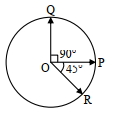
Three vectors $\overrightarrow{\mathrm{OP}}, \overrightarrow{\mathrm{OQ}}$ and $\overrightarrow{\mathrm{OR}}$ each of magnitude $A$ are acting as shown in figure. The resultant of the three vectors is $A \sqrt{x}$. The value of $x$ is. . . . . . . . .