MCQ
The dimensions of surface tension are
  • A
    $M{L^{ - 1}}{T^{ - 2}}$
  • B
    $ML{T^{ - 2}}$
  • C
    $M{L^{ - 1}}{T^{ - 1}}$
  • $M{T^{ - 2}}$

Answer

Correct option: D.
$M{T^{ - 2}}$
d
(d) Surface tension = $\frac{{{\rm{Force}}}}{{{\rm{Length}}}} = \frac{{[ML{T^{ - 2}}]}}{L} = [M{T^{ - 2}}]$

Need a full question paper?

Generate a complete, print-ready paper with questions like this in minutes — across 16+ boards, with answer keys.

Start Generating Free

Similar questions

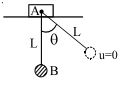
$A$ small ball $B$ of mass $m$ is suspended with light inelastic string of length $L$ from $a$ block $A$ of same mass $m$ which can move on smooth horizontal surface as shown in the figure. The ball is displaced by angle $\theta$ from equilibrium position & then released. Tension in string when it is vertical, is
To project a body of mass $m$ from earth's surface to infinity, the required kinetic energy is (assume, the radius of earth is $R_E, g=$ acceleration due to gravity on the surface of earth) :
The efficiency of a Carnot engine operating with reservoir temperature of $100\,^{\circ} C$ and $-23\,^{\circ} C$ will be
Two sound waves with wavelengths $5.0\,\, m$ and $5 .5\,\, m$ respectively, each propagate in a gas with velocity $330\,\, m/s.$ We expect the following number of beats per second. 
If the length of a stretched string is doubled and the tension is four times then new frequency will be times of old frequency.
The displacement of a particle varies according to the relation $x = 4(cos\pi t + sin\pi t).$ The amplitude of the particle is
A particle starts moving rectilinearly at time $t = 0$ such that its velocity $'v'$ changes with time $'t'$ according to the equation $v = t^2 - t$ where $t$ is in seconds and $v$ is in $m/s.$ The time interval for which the particle retards is
A car is moving along a straight road with a uniform acceleration. It passes through two points $P$ and $Q$ separated by a distance with velocity $30\; km / h$ and $40\; km / h$ respectively. The velocity of the car midway between $P$ and $Q$
A uniform disc of mass $M$ and radius $R$ is rotating about a horizontal axis passing through its centre with angular velocity $\omega $. A piece of mass $m$ breaks from the disc and flies off vertically upwards. The angular speed of the disc will be
If the equation of transverse wave is $y = 5\sin 2\pi \left[ {\frac{t}{{0.04}} - \frac{x}{{40}}} \right]$, where distance is in $ cm$ and time in second, then the wavelength of the wave is .... $cm$