MCQ
The dimensions of universal gravitational constant are
  • A
    ${M^{ - 2}}{L^2}{T^{ - 2}}$
  • ${M^{ - 1}}{L^3}{T^{ - 2}}$
  • C
    $M{L^{ - 1}}{T^{ - 2}}$
  • D
    $M{L^2}{T^{ - 2}}$

Answer

Correct option: B.
${M^{ - 1}}{L^3}{T^{ - 2}}$
b
(b) $F = \frac{{G{m_1}{m_2}}}{{{d^2}}} \Rightarrow G = \frac{{F{d^2}}}{{{m_1}{m_2}}}$

$[G] = \frac{{[ML{T^{ - 2}}][{L^2}]}}{{[{M^2}]}} = [{M^{ - 1}}{L^3}{T^{ - 2}}]$

Need a full question paper?

Generate a complete, print-ready paper with questions like this in minutes — across 16+ boards, with answer keys.

Start Generating Free

Similar questions

For a particle in a non-uniform accelerated circular motion
A particle is projected from the ground with an initial speed $\upsilon $ at an angle $\theta $ with horizontal. The average velocity of the particle between its point of projection and highest point of trajectory is
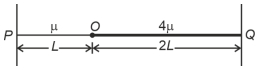
Two uniform strings of mass per unit length $\mu$ and $4 \mu$, and length $L$ and $2 L$, respectively, are joined at point $O$, and tied at two fixed ends $P$ and $Q$, as shown in the figure. The strings are under a uniform tension $T$. If we define the frequency $v_0=\frac{1}{2 L} \sqrt{\frac{T}{\mu}}$, which of the following statement($s$) is(are) correct?

$(A)$ With a node at $O$, the minimum frequency of vibration of the composite string is $v_0$

$(B)$ With an antinode at $O$, the minimum frequency of vibration of the composite string is $2 v_0$

$(C)$ When the composite string vibrates at the minimum frequency with a node at $O$, it has $6$ nodes, including the end nodes

$(D)$ No vibrational mode with an antinode at $O$ is possible for the composite string
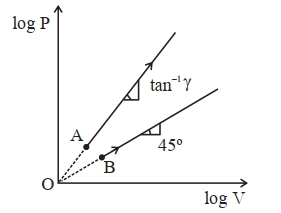
Two thermodynamical process are shown in the figure. The molar heat capacity for process $A$ and $B$ are $C_A$ and $C_B$. The molar heat capacity at constant pressure and constant volume are represented by $C_P$ and $C_V$, respectively. Choose the correct statement.
The periodic time of a communication satellite is ......... $hours$
The number of particles crossing per unit area perpendicular to X-axis in unit time is:
$\text{N}=-\text{D}\frac{\text{n}_2-\text{n}_1}{\text{x}_2-\text{x}_1}$
Where n1 and n2 are number of particles per unit volume for the value of x1 and x2 respectively. The dimensions of diffusion constant D are:
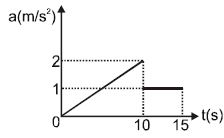
A particle starts from rest and undergoes an acceleration as shown in figure. The  velocity-time graph from figure will have shape.
The temperatures of two bodies $A$ and $B$ are respectively ${727^o}C$ and ${327^o}C$. The ratio ${H_A}:{H_B}$ of the rates of heat radiated by them is
If a particle is moving along straight line with increasing speed, then
Two forces $P + Q$ and $P -Q$ make angle $2 \alpha$ with each other and their  resultant make $\theta$ angle with bisector of angle between them. Then :