MCQ
The dimensions of universal gravitational constant are
  • A
    $M^{-2} L^2 T^{-2}$
  • $M^{-1} L^3 T^{-2}$
  • C
    $M L^{-1} T^{-2}$
  • D
    $M L^2 T^{-2}$

Answer

Correct option: B.
$M^{-1} L^3 T^{-2}$
(b)
$F=\frac{G m_1 m_2}{d^2} \Rightarrow G=\frac{F d^2}{m_1 m_2}$
$\therefore[G]=\frac{\left[M L T^{-2}\right]\left[L^2\right]}{\left[M^2\right]}=\left[M^{-1} L^3 T^{-2}\right]$

Need a full question paper?

Generate a complete, print-ready paper with questions like this in minutes — across 16+ boards, with answer keys.
Start Generating Free

Similar questions

A machine which is $75$ percent efficient, uses $12$ joules of energy in lifting up a $1 \mathrm{~kg}$ mass through a certain distance. The mass is then allowed to fall through that distance. The velocity at the end of its fall is (in $m s^{-1}$ )
Excess pressure of one soap bubble is four times more than the other. Then the ratio of volume of first bubble to another one is
An alpha particle enters a hollow tube of $4 m$ length with an initial speed of $1 km / s$. It is accelerated in the tube and comes out of it with a speed of $9 km / s$. The time for which it remains inside the tube is
A rocket is fired upward from the earth's surface such that it creates an acceleration of $19.6 m / sec$. If after $5 sec$ its engine is switched off, the maximum height of the rocket from earth's surface would be
The far point of a myopia eye is at $40 \mathrm{~cm}$. For removing this defect, the power of lens required will be
For a small temperature difference between the body and the surroundings the relation between the rate of loss heat $R$ and the temperature of the body is depicted by
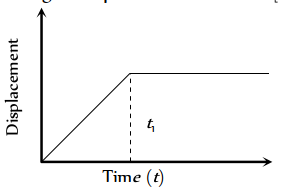
The $x-t$ graph shown in figure represents
Image
On a glass plate a light wave is incident at an angle of $60^{\circ}$. If the reflected and the refracted waves are mutually perpendicular, the refractive index of material is
A $500 W$ heating unit is designed to operate from a 115 volt line. If the line voltage drops to 110 volt, the percentage drop in heat output will be
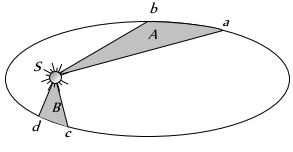
The figure shows the motion of a planet around the sun in an elliptical orbit with sun at the focus. The shaded areas A and B are also shown in the figure which can be assumed to be equal. If $t_1$ and $t_2$ represent the time for the planet to move from $a$ to $b$ and $d$ to $c$ respectively, then
Image