MCQ
The dipole moment is the highest for
- ATrans$-2-$butene
- B$1, 3-$Dimethylbenzene
- ✓Acetophenone
- DEthanol
(i) $\mathop { - \mathop C\limits_|^| - \mathop C\limits^| = \mathop C\limits^| - \mathop C\limits_|^| - }\limits_{{\text{Trans - 2 butene (}}u = 0{\text{)}}} $
(iv) $\mathop {{C_2}{H_5}OH}\limits_{ + I} $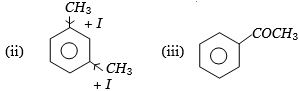
Generate a complete, print-ready paper with questions like this in minutes — across 16+ boards, with answer keys.
$U\,\,\, 1s^2 \,2s^2 \,2p^3$
$V\,\,\, 1s^2\,2s^2 \,2p^6 \,3s^1$
$W\,\,\, 1s^2\,2s^2\, 2p^6\,3s^2\,3p^2$
$X\,\,\, 1s^2\,2s^2\,2p^6\,3s^2\,3p^6\,3d^5\, 4s^2$
$Y\,\,\, 1s^2\, 2s^2\,2p^6\,3s^2\,3p^6\,3d^{10}\, 4s^2\, 4p^6$
Determine which sequence of elements satisfy the following statements :
$(i)$ Element forms a carbonate which is not decomposed by heating
$(ii)$ Element is most likely to form coloured ionic compounds
$(iii)$ Element has largest atomic radius
$(iv)$ Element forms only acidic oxide
$Ca_3(PO_4)_2 + SiO_2 + C + O_2 + H_2O \to CaSiO_3 + CO_2 + H_3PO_4$
If $1.0\ kg$ each of calcium phosphate and silica are used with excess of $C$ , $O_2$ and $H_2O$ , what is maximum quantity of phosphoric acid that can be produced. $(Ca = 40, P = 31, Si = 28)$