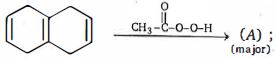
MCQ
The dipole moment of $HBr$ is $1.6 \times {10^{ - 30}}\,cm$ and interatomic spacing is $1\,\mathop A\limits^o $. The $\%$ ionic character of $HBr$ is
- A$7$
- ✓$10$
- C$15$
- D$27$
Dipole moment of $HBr = 1.6 \times {10^{ - 30}}$
Inter atomic spacing $ = 1\,{\rm{{\mathop A\limits^o }}} = 1 \times {10^{ - 10}}\,m$
$\%$ of ionic character in
$HBr = \frac{{{\rm{dipole}}\,{\rm{moment}}\,{\rm{of}}\,HBr \times 100}}{{{\rm{inter}}\,{\rm{spacing}}\,{\rm{distance}}\, \times q}}$
$ = \frac{{1.6 \times {{10}^{ - 30}}}}{{1.6 \times {{10}^{ - 19}} \times {{10}^{ - 10}}}} \times 100$
$ = {10^{ - 30}} \times {10^{29}} \times 100 = {10^{ - 1}} \times 100$ $ = 0.1 \times 100 = 10\% $
Generate a complete, print-ready paper with questions like this in minutes — across 16+ boards, with answer keys.
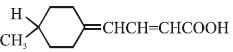
$1.$ The succeeding operations that enable this transformation of states are
$(A)$ Heating, cooling, heating, cooling
$(B)$ Cooling, heating, cooling, heating
$(C)$ Heating, cooling, cooling, heating
$(D)$ Cooling, heating, heating, cooling
$2.$ The pair of isochoric processes among the transormation of states is
$(A)$ $K$ to $L$ and $L$ to $M$
$(B)$ $L$ to $M$ and $N$ to $K$
$(C)$ $L$ to $M$ and $M$ to $N$
$(D)$ $M$ to $N$ and $N$ to $K$
Give the answer question $1$ and $2.$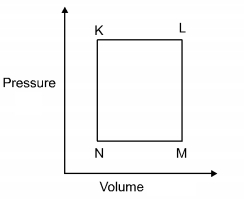
$\begin{array}{*{20}{c}}
{C{H_3} - CH = C - C{H_2} - C{H_3}} \\
{|\,\,} \\
{\,\,\,\,\,\,\,\,\,\,\,\,\,\,\,\,\,\,\,\,\,\,\,\,\,\,\,\,\,\,\,\,\,\,\,\,C{H_2} - C{H_2} - C{H_3}}
\end{array}$