MCQ
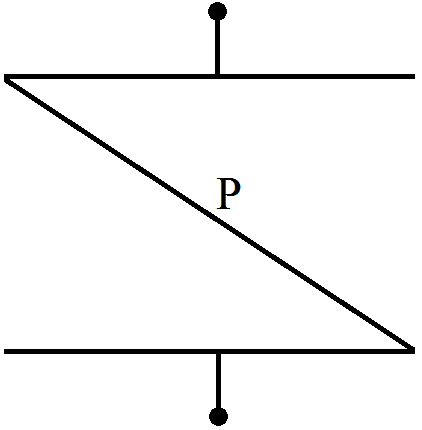
The direction of electric field is from:
- APositive to negative plate.
- BNegative to positive plate.
- CBoth a and b.
- DNone.
Generate a complete, print-ready paper with questions like this in minutes — across 16+ boards, with answer keys.
A magnet oscillating in a horizontal plane has a time period of 2 second at a place where the angle of dip is 30o and 3 seconds at another place where the angle of dip is 60o. The ratio of resultant magnetic fields at the two places is
|
(a) |
(b) |
(c) |
(d) |
The dispersive powers of glasses of lenses used in an achromatic pair are in the ratio 5 : 3. If the focal length of the concave lens is 15 cm, then the nature and focal length of the other lens would be
|
(a) Convex, 9 cm |
(b) Concave, 9 cm |
(c) Convex, 25 cm |
(d) Concave, 25 cm |
The ratio of the magnetic field at the centre of a current carrying circular wire and the magnetic field at the centre of a square coil made from the same length of wire will be
|
(a) |
(b) |
(c) |
(d) |
If ne and vd be the number of electrons and drift velocity in a semiconductor. When the temperature is increased
|
(a) ne increases and vd decreases |
(b) ne decreases and vd increases |
| (c) Both ne and vd increases | (d) Both ne and vd decreases |
According to Joule's law, if the potential difference across a conductor having a material of specific resistance remains constant, then the heat produced in the conductor is directly proportional to
|
(a) ρ |
(b) |
(c) |
(d) |
Consider the following two statements A and B, and identify the correct choice out of given answers
A. Thermo e.m.f. is minimum at neutral temperature of a thermocouple
B. When two junctions made of two different metallic wires are maintained at different temperatures, an electric current is generated in the circuit.
|
(a) A is false and B is true |
(b) A is true and B is false |
|
(c) Both A and B are false |
(d) Both A and B are true |
$\text{y}=\text{a}_1\sin\omega\text{t}$
$\text{y}=\text{a}_2\sin(\omega\text{t}+\in)$
$\text{y}=\text{a}_1\sin2\omega\text{t}$
$\text{y}=\text{a}_2\sin2(\omega\text{t}+\in)$
What causes chromatic aberration?


