MCQ
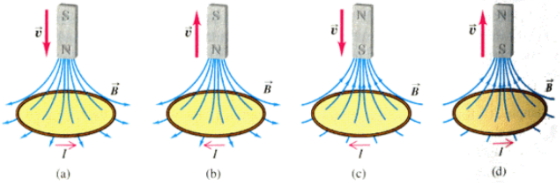
The direction of induced e.m.f. during electromagnetic induction is given by
  • A
    Faraday's law
  • Lenz's law
  • C
    Maxwell's law
  • D
    Ampere's law

Answer

Correct option: B.
Lenz's law
b
(b) The rule is called Lenz's Law. You already appear to know how to determine the direction of the magnetic field due to a current in a loop, which is part of the answer. What Lenz's Law tells us is that the direction of the induced current in the loop is such that it "opposes the change in the flux".

Need a full question paper?

Generate a complete, print-ready paper with questions like this in minutes — across 16+ boards, with answer keys.

Start Generating Free

Similar questions

Given below are two statements. One is labelled as Assertion (A) and the other is labelled as Reason (R).
Assertion (A) : The binding energy per nucleon is found to be practically independent of the atomic number A , for nuclei with mass numbers between 30 and 170.
Reason (R): Nuclear force is long range.
In the light of the above statements, choose the correct answer from the options given below :
An $e.m.f.$ of $15\,volt$ is applied in a circuit containing $5\,henry$ inductance and $10\,ohm$ resistance. The ratio of the currents at time $t \to \infty$ and at $t = 1\,second$ is
A thin tube sealed at both ends is $100\, cm$ long. It lies horizontally, the middle $20\, cm$ containing mercury and two equal ends containing air at standard atmospheric pressure . If the tube is now turned to a vertical position, by what amount will the mercury be displaced ? (Given : cross-section of the tube can be assumed to be uniform) ........ $cm$
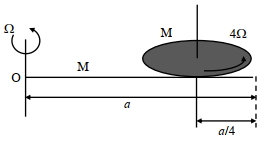
A thin rod of mass $M$ and length $a$ is free to rotate in horizontal plane about a fixed vertical axis passing through point $O$. A thin circular disc of mass $M$ and of radius $a / 4$ is pivoted on this rod with its center at a distance $a / 4$ from the free end so that it can rotate freely about its vertical axis, as shown in the figure. Assume that both the rod and the disc have uniform density and they remain horizontal during the motion. An outside stationary observer finds the rod rotating with an angular velocity $\Omega$ and the disc rotating about its vertical axis with angular velocity $4 \Omega$. The total angular momentum of the system about the point $O$ is $\left(\frac{ M a^2 \Omega}{48}\right) n$. The value of $n$ is$. . . . .$
What is the lateral shift of a ray refracted through a parallel-sided glass slab of thickness ' $h$ ' in terms of the angle of incidence ' $i$ ' and angle of refraction ' $r$ ', if the glass slab is placed in air medium ?
With respect to air critical angle in a medium for light of red colour $[{\lambda _1}]$ is $\theta$. Other facts remaining same, critical angle for light of yellow colour $[{\lambda _2}$] will be
The unit of electric permittivity is
The variation of density of water with temperature is represented by the
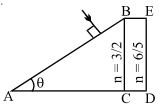
In the figure $ABC$ is the cross section of a right angled prism and $BCDE$ is the cross section of a glass slab. The value of $\theta$ so that light incident normally on the face $AB$ does not cross the face $BC$ is (given $sin^{-1} (3/5) = 37^o)$
If the initial velocity in horizontal direction of a projectile is unit vector $\hat{i}$ and the equation of trajectory is $y =5 x (1- x )$. The $y$ component vector of the initial velocity is.

(Take $g=10\,m / s ^{2}$ )