MCQ
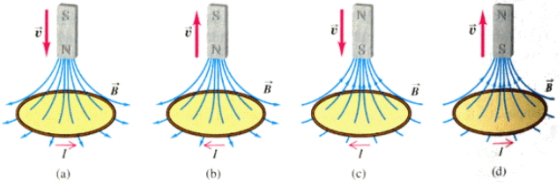
The direction of induced e.m.f. during electromagnetic induction is given by
  • A
    Faraday's law
  • Lenz's law
  • C
    Maxwell's law
  • D
    Ampere's law

Answer

Correct option: B.
Lenz's law
b
(b) The rule is called Lenz's Law. You already appear to know how to determine the direction of the magnetic field due to a current in a loop, which is part of the answer. What Lenz's Law tells us is that the direction of the induced current in the loop is such that it "opposes the change in the flux".

Need a full question paper?

Generate a complete, print-ready paper with questions like this in minutes — across 16+ boards, with answer keys.
Start Generating Free

Similar questions

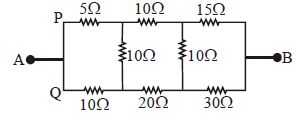
In the arangement of resistances shown below, the effective resistance between points $A$ and $B$ is ............... $\Omega$
In which thermodynamic process, volume remains same
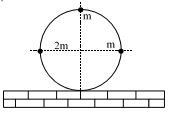
$A$ ring of mass $m$ and radius $R$ has three particles attached to the ring as shown in the figure. The centre of the ring has a speed $v_0$. The kinetic energy of the system is: (Slipping is absent)
A battery has $e.m.f.$ $4\, V$ and internal resistance $r$. When this battery is connected to an external resistance of $2\, ohms$, a current of $1\, amp$. flows in the circuit. How much current will flow if the terminals of the battery are connected directly .......... $amp$
A particle of mass $9.1 \times 10^{-31}\, {kg}$ travels in a medium with a speed of $10^{6}\, {m} / {s}$ and a photon of a radiation of linear momentum $10^{-27} \,{kg}\, {m} / {s}$ travels in vacuum. The wavelength of photon is $....$ times the wavelength of the particle.
In a potentiometer wire experiment the $\mathrm{emf}$ of a battery in the primary circuit is $20\,V$ and its internal resistance is $5\,\Omega$ . There is a resistance box in series with the battery and the potentiometer wire, whose resistance can be varied from $120\,\Omega$ to $170\,\Omega$ . Resistance of the potentiometer wire is $75\,\Omega$ . The following potential differences can be measured using this potentiometer.
A light of wavelength $5890 \;\mathring A$ falls normally on a thin air film. The minimum thickness of the film such that the film appears dark in reflected light
The nuclear radius is given by $R=r_0 A^{1 / 3}$, where $r_0$ is constant and $A$ is the atomic mass number. Then, the nuclear mass density of $U^{238}$ is
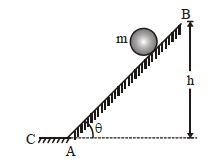
A sphere of mass $m$ comes down on a smooth inclined plane from a point $B$ at a height of $h$ from rest. The magnitude of change in momentum of the particle between the position $A$ and $C$ (assuming the angle of inclination of the plane as $\theta $ with respect to the horizontal) is
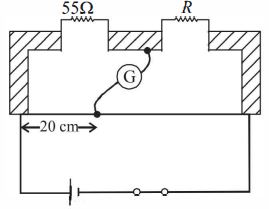
Shown in the figure below is a meter-bridge set up with null deflection in the galvanometer. The value of the unknown resistor $R$ is ............. $\Omega$