Question
In which thermodynamic process, volume remains same

Answer

An isochoric process is one in which the volume is held constant, meaning that the work done by the system will be $zero.$ It follows that, for the simple system of two dimensions, any heat energy transferred to the system externally will be absorbed as internal energy.

Need a full question paper?

Generate a complete, print-ready paper with questions like this in minutes — across 16+ boards, with answer keys.
Start Generating Free

Similar questions

A conducting wire is dropped along east-west direction, then
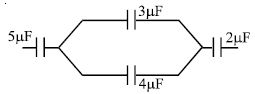
If charge on left plane of the $5\ \mu F$ capacitor in the circuit segment shown in the figure is $-20\ \mu C$, the charge on the right plate of $3\ \mu F$ capacitor is.......$ \mu C$
The pressure that has to be applied to the ends of a steel wire of length $10\ cm$ to keep its length constant when its temperature is raised by $100^o C$ is: (For steel Young's modulus is $2 \times 10^{11}$ $Nm^{-1}$ and coefficient of thermal expansion is $1.1 \times 10^{-5}$ $K^{-1}$ )
A condenser of capacity $C$ is charged to a potential difference of $V_1$ . The plates of the condenser are then connected to an ideal inductor of inductance $L$. The current through the inductor when the potential difference across the condenser reduces to $V_2$ is
Compound $"x"$ having molecular formula $C_3H_6O$ , reduced by Red $P/HI$ to gives compound $'y'(C_3H_8)$ , but reduces tollen's reagent, what will be possible structure of $"x"$
An antenna behaves as resonant circuit only when its length is
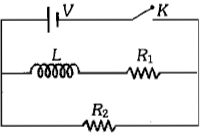
In the circuit shown below, the key $K$ is closed at $t = 0$. The current through the battery is
The electrostatic energy of $Z$ protons uniformly distributed throughout a spherical nucleus of radius $R$ is given by

$E=\frac{3}{5} \frac{Z(Z-1) e^2}{4 \pi \varepsilon_0 R}$

The measured masses of the neutron, ${ }_1^1 \mathrm{H},{ }_7^{15} \mathrm{~N}$ and ${ }_8^{15} \mathrm{O}$ are $1.008665 \mathrm{u}, 1.007825 \mathrm{u}$, $15.000109 \mathrm{u}$ and $15.003065 \mathrm{u}$, respectively. Given that the radii of both the ${ }_7^{15} \mathrm{~N}$ and ${ }_8^{15} \mathrm{O}$ nuclei are same, $1 \mathrm{u}=931.5 \mathrm{MeV} / \mathrm{c}^2$ ( $c$ is the speed of light) and $e^2 /\left(4 \pi \varepsilon_0\right)=1.44 \mathrm{MeV} \mathrm{fm}$. Assuming that the difference between the binding energies of ${ }_7^{15} \mathrm{~N}$ and ${ }_8^{15} \mathrm{O}$ is purely due to the electrostatic energy, the radius of either of the nuclei is

$\left(1 \mathrm{fm}=10^{-15} \mathrm{~m}\right.$ )

Dimensional formula $M{L^{ - 1}}{T^{ - 2}}$ does not represent the physical quantity
An electric kettle has two coils. When one of these is switched on, the water in the kettle boils in $6\,\min$ . When the other coil is switched on, the water boils in $3\,\min$. If the two coils are connected in series, the time taken to boil the water in the kettle is ............. $min$