MCQ
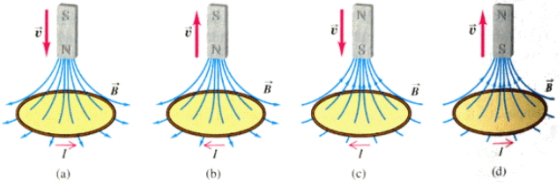
The direction of induced e.m.f. during electromagnetic induction is given by
  • A
    Faraday's law
  • Lenz's law
  • C
    Maxwell's law
  • D
    Ampere's law

Answer

Correct option: B.
Lenz's law
b
(b) The rule is called Lenz's Law. You already appear to know how to determine the direction of the magnetic field due to a current in a loop, which is part of the answer. What Lenz's Law tells us is that the direction of the induced current in the loop is such that it "opposes the change in the flux".

Need a full question paper?

Generate a complete, print-ready paper with questions like this in minutes — across 16+ boards, with answer keys.
Start Generating Free

Similar questions

A vibration magnetometer placed in magnetic meridian has a small bar magnet. The magnet executes oscillations with a time period of $2\, sec$ in the earth's horizontal magnetic field of $24$ $microtesla$ . When a horizontal field of $18$ $microtesla$ is produced opposite to the earth's field by placing a current carrying wire, the new time period of magnet will be....$s$
Which of the following statements is correct?
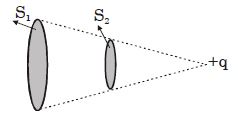
Two surfaces $S_1$ and $S_2$ are shown in figure. Flux associated with $S_1$ is ${\phi _1}$ and $S_2$ is ${\phi _2}$. Which is correct ?
When a photon of light collides with a metal surface, number of electrons, (if any) coming out is
If two conducting spheres are separately charged and then brought in contact
A generator produces a voltage that is given by $V = 240\,sin \,120\,t$, where t is in seconds. The frequency and $ r.m.s.$ voltage are
When $\text{npn}$ transistor is used as an amplifier:
When photon of energy 4.25 eV strike the surface of a metal A, the ejected photoelectrons have maximum kinetic energy $\mathrm{T}_{\mathrm{A}} ~\mathrm{eV}$ and de-Brolie wavelength $\lambda_{\mathrm{A}}$. The maximum kinetic energy of photoelectrons liberated from another metal B by photon of energy 4.70 eV is $\mathrm{T}_{\mathrm{B}}=\left(\mathrm{T}_{\mathrm{A}}-1.50\right) \mathrm{eV}$. If the de-Broglie wavelength of these photoelectrons is $\lambda_{\mathrm{A}}=2 \lambda_{\mathrm{B}}$, then
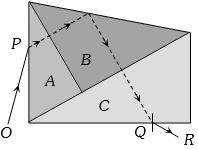
Three glass prisms $A, B$ and $C $ of same refractive index are placed in contact with each other as shown in figure, with no air gap between the prisms. Monochromatic ray of light $OP$ passes through the prism assembly and emerges as $QR.$ The conditions of minimum deviation is satisfied in the prisms
Meteors are