MCQ
The direction of poynting vector represents
  • A
    The direction of electric field
  • B
    The direction of magnetic field
  • The direction of propagation of $EM$ wave
  • D
    The direction opposite to the propagation of $EM$ wave

Answer

Correct option: C.
The direction of propagation of $EM$ wave
c
(c)

$\bar{S}=\frac{\vec{E} \times \bar{B}}{\mu_0}$

$\vec{E} \times \vec{B} \Rightarrow$ direction of wave propagation

Need a full question paper?

Generate a complete, print-ready paper with questions like this in minutes — across 16+ boards, with answer keys.
Start Generating Free

Similar questions

The conductivity of a semiconductor increases with increase in temperature because:
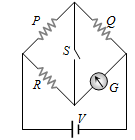
In the circuit shown P ≠ R, the reading of the galvanometer is same with switch S open or closed. Then

A variable condenser is permanently connected to a 100 V battery. If the capacity is changed from 2μF to 10 μF, then change in energy is equal to
Between the plates of a parallel plate condenser there is 1mm thick paper of dielectric constant 4. It is charged at 100 volt. The electric field in volt/metre between the plates of the capacitor is
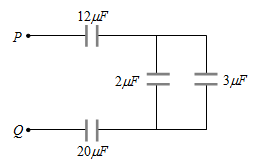
In the circuit diagram shown in the adjoining figure, the resultant capacitance between P and Q is
Let p and E denote the linear momentum and the energy of a photon. For another photon of smaller wavelength $($in same medium$):$
Visible light passing through a circular hole forms a diffraction disc of radius $0.1\ mm$ on a screen. If an $X-$ray is passed through the same setup, the radius of the diffraction disc will be:
The focal length of the obejctive lens and the eye piece of a microscope are $2\, cm$ and $5\, cm$ respectively and the distance between them is $20\, cm$. Find the distance of  the object from objective lens when final image is seen by the eye is $25 \,cm$ from the  eye piece......$cm$
A series combination of three capacitors of capacities 1μF, 2 μF and 8 μF is connected to a battery of e.m.f. 13 volt. The potential difference across the plates of 2 μF capacitor will be
An alpha nucleus of energy $\frac{1}{2}m{v^2}$ bombards a heavy nuclear target of charge $Ze$. Then the distance of closest approach for the alpha nucleus will be proportional to