MCQ
The displacement is given by $x = 2{t^2} + t + 5$, the acceleration at $t = 2\;s$ is.........$m/{s^2}$
  • $4$
  • B
    $8$
  • C
    $10$
  • D
    $15$

Answer

Correct option: A.
$4$
a
(a) Displacement $x = 2{t^2} + t + 5$

Velocity $ = \frac{{dx}}{{dt}} = 4t + 1$

Acceleration $ = \frac{{{d^2}x}}{{d{t^2}}} = 4$ i.e. independent of time

Hence acceleration $ = 4\;m/{s^2}$

Need a full question paper?

Generate a complete, print-ready paper with questions like this in minutes — across 16+ boards, with answer keys.
Start Generating Free

Similar questions

The frequency of an alternating voltage is $50$ cycles/sec and its amplitude is $120\,V$. Then the $ r.m.s$. value of voltage is........$V$
A particle has simple harmonic motion. The equation of its motion is $x = 5\sin \left( {4t - \frac{\pi }{6}} \right)$, where $x$ is its displacement. If the displacement of the particle is $3$ units, then it velocity is
To break a wire of one meter length, minimum $40 \,kg \,wt$. is required. Then the wire of the same material of double radius and $6 \,m$ length will require breaking weight ....... $kg \,wt$
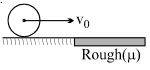
$A$ ring of mass $M$ and radius $R$ sliding with a velocity $v_0$ suddenly enters into rough surface where the coefficient of friction is $\mu$ , as shown in figure. Choose the correct statement $(s)$
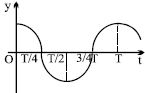
The displacement-time graph of a particle executing $SHM$ is shown. Which of the following statements is/are true ?
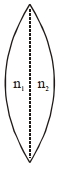
A thin convex lens is made of two materials with refractive indices $n_1$ and $n_2$, as shown in figure. The radius of curvature of the left and right spherical surfaces are equal. $f$ is the focal length of the lens when $n_1=n_2=n$. The focal length is $f+\Delta f$ when $n_1=n$ and $n_2=n+\Delta n$. Assuming $\Delta n \ll$ (n-1) and $1< n <2$, the correct statement(s) is/are :

$(1)$ The relation between $\frac{\Delta f}{f}$ and $\frac{\Delta n}{n}$ remains unchanged if both the convex surfaces are replaced by concave surfaces of the same radius of curvature.

$(2)$ $\left|\frac{\Delta f }{ f }\right|<\left|\frac{\Delta n }{ n }\right|$

$(3)$ For $n =1.5, \Delta n =10^{-3}$ and $f =20 cm$, the value of $|\Delta f |$ will be $0.02 cm$ (round off to $2^{\text {nd }}$ decimal place)

$(4)$ If $\frac{\Delta n }{ n }<0$ then $\frac{\Delta f }{ f }>0$
The current in an inductor is given by $\mathrm{I}=(3 \mathrm{t}+8)$ where $t$ is in second. The magnitude of induced emf produced in the inductor is $12 \mathrm{mV}$. The selfinductance of the inductor___________.$\mathrm{mH}$.
The root mean square speed of hydrogen molecules at $300$ $K$ is $1930\, m/s.$ Then the root mean square speed of oxygen molecules at $900\, K$ will be ....... $m/s$
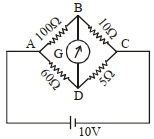
The four arms of a Wheatstone bridge have resistances as shown in the figure. A  galvanometer of $15\, \Omega$ resistance is connected across $BD$. Calculate the current through the galvanometer when a potential difference of $10\, V$ is maintained across $AC.$
If two electric bulbs have $40\,W$ and $60\,W$ rating at $220\,V$, then the ratio of their resistances will be