The four arms of a Wheatstone bridge have resistances as shown in the figure. A galvanometer of $15\, \Omega$ resistance is connected across $BD$. Calculate the current through the galvanometer when a potential difference of $10\, V$ is maintained across $AC.$
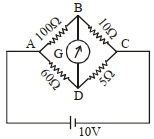
JEE MAIN 2021, Diffcult
Download our app for free and get started
$\frac{x-10}{100}+\frac{x-y}{15}+\frac{x-0}{10}=0$
$53 x-20 y=30 \ldots \ldots(1)$
$\frac{y-10}{60}+\frac{y-x}{15}+\frac{y-0}{5}=0$
$17 y -4 x =10$
on solving $(1)\,\&\,(2)$
$x=0.865$
$y =0.792$
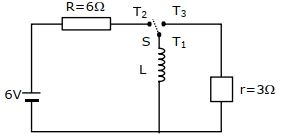
$\Delta V =0.073 R =15\, \Omega$
$i =4.87 \,mA$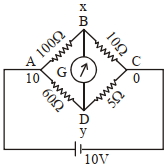

Download our appand get started for free
Experience the future of education. Simply download our apps or reach out to us for more information. Let's shape the future of learning together!No signup needed.*
Similar Questions
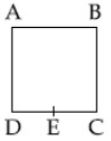
- 1A wire of resistance $R$ is bent to form a square $ABCD$ as shown in the figure. The effective resistance between $E$ and $C$ is ( $E$ is mid-point of arm $CD$ )View Solution
- 2A wire has resistance of $24\,\Omega$ is bent in the following shape. The effective resistance between $A$ and $B$ is .............. $\Omega$View Solution
- 3Which of the four resistances $P, Q, R$ and $S$ generate the greatest amount of heat when a current flows from $A$ to $B$ ?View Solution
- 4At what temperature will the resistance of a copper wire become three times its value at $0\,^oC$ ................. $^oC$ (Temperature coefficient of resistance for copper = $4 × 10^{-3} \,per\, \,^oC$ )View Solution
- 5A battery of $24\,cells$ , each of emf $1.5\,V$ and internal resistance $2\,\Omega$ is to be connected in order to send the maximum current through a $12\,\Omega$ resistor. The correct arrangement of cells will beView Solution
- 6The figure here shows a portion of a circuit. What are the magnitude and direction of the current i in the lower right-hand wire .................... $A$View Solution
- 7A conducting wire of length $ l$ area of cross-section $A$ and electric resistivity $\rho$ is connected between the terminals of a battery. $A$ potential difference $V$ is developed between its ends, causing an electric current.If the length of the wire of the same material is doubled and the area of cross-section is halved, the resultant current would beView Solution
- 8In the circuit shown, $R_1$ is increased. What happens to the reading of the voltmeter (ideal)?View Solution
- 9When a current of $2\, A$ flows in a battery from negative to positive terminal, the potential difference across it is $12\, V$. If a current of $3 \,A$ flows in the opposite direction potential difference across the terminals of the battery is $15\, V$, the $emf$ of the battery is ................ $\mathrm{V}$View Solution
- 10Consider an electrical circuit containing a two way switch $^{\prime}{S}^{\prime}$. Initially ${S}$ is open and then ${T}_{1}$ is connected to ${T}_{2} .$ As the current in ${R}=6 \,\Omega$ attains a maximum value of steady state level, ${T}_{1}$ is disconnected from ${T}_{2}$ and immediately connected to ${T}_{3} .$ Potential drop across ${r}=3\, \Omega$ resistor immediately after $T_{1}$ is connected to $T_{3}$ is $....\,V.$ (Round off to the Nearest Integer)View Solution