The displacement of an oscillator is given by $x = a\, \sin \, \omega t + b\, \cos \, \omega t$. where $a, b$ and $\omega$ are constant. Then :-
Medium
Download our app for free and get started
$x=\sin \omega t+b \cos \omega t$
$\mathrm{x}=\sqrt{\mathrm{a}^{2}+\mathrm{b}^{2}}\left[\frac{\mathrm{a}}{\mathrm{a}^{2}+\mathrm{b}^{2}} \sin \omega \mathrm{t}+\frac{1}{\sqrt{\mathrm{a}^{2}+\mathrm{b}^{2}}} \cos \omega \mathrm{t}\right]$
$\mathrm{x}=\sqrt{\mathrm{a}^{2}+\mathrm{b}^{2}}[\cos \phi \sin \omega \mathrm{t}+\sin \phi \cos \omega \mathrm{t}]$
Let $\cos \phi=\frac{a}{\sqrt{a^{2}+b^{2}}}$
$\therefore \mathrm{x}_{2} \sqrt{\mathrm{a}^{2}+\mathrm{b}^{2}} \sin (\omega \mathrm{t}+\phi)$ this is condition of $SHM$

Download our appand get started for free
Experience the future of education. Simply download our apps or reach out to us for more information. Let's shape the future of learning together!No signup needed.*
Similar Questions
- 1For a particle executing $S.H.M.,\, x =$ displacement from equilibrium position, $v =$ velocity at any instant and $a =$ acceleration at any instant, thenView Solution
- 2The position, velocity and acceleration of a particle executing simple harmonic motion are found to have magnitudes of $4 \mathrm{~m}, 2 \mathrm{~ms}^{-1}$ and $16 \mathrm{~ms}^{-2}$ at a certain instant. The amplitude of the motion is $\sqrt{\mathrm{x}} \mathrm{m}$ where $\mathrm{x}$ is. . . . . . .View Solution
- 3In a linear simple harmonic motion $(SHM)$View Solution
$(A)$ Restoring force is directly proportional to the displacement.
$(B)$ The acceleration and displacement are opposite in direction.
$(C)$ The velocity is maximum at mean position.
$(D)$ The acceleration is minimum at extreme points.
Choose the correct answer from the options given below :
- 4A simple perdulum performs simple harmonic motion about $x=0$ with an amplitude $a$ and time period $T$. The speed of the pendulum at $x=a/2$ will beView Solution
- 5View SolutionWhich of the diagrams shown in figure represents variation of total mechanical energy of a pendulum oscillating in water as function of time ?
- 6A pendulum suspended from the ceiling of a train has a period $T$ when the train is at rest. When the train travels same distance per unit time, the period of oscillation isView Solution
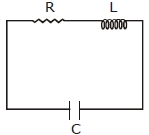
- 7An $LCR$ circuit is equivalent to a damped pendulum. In an $LCR$ circuit the capacitor is charged to $Q_0$ and then connected to the $L$ and $R$ as shown below.View Solution
If a student plots graphs of the square of maximum charge $( Q_{Max} ^2 )$ on the capacitor with time$(t)$ for two different values $L_1$ and $L_2 (L_1 > L_2)$ of $L$ then which of the following represents this graph correctly? (plots are schematic and not drawn to scale)
- 8A particle executes simple harmonic motion represented by displacement function as $x(t)=A \sin (\omega t+\phi)$View Solution
If the position and velocity of the particle at $t=0\, {s}$ are $2\, {cm}$ and $2\, \omega \,{cm} \,{s}^{-1}$ respectively, then its amplitude is $x \sqrt{2} \,{cm}$ where the value of $x$ is ..... .
- 9A body performs $S.H.M.$ Its kinetic energy $K$ varies with time $t$ as indicated by graphView Solution
- 10Assuming all pulleys, springs and string massless. Consider all surface smooth. Choose the correct statement $(s)$View Solution