MCQ
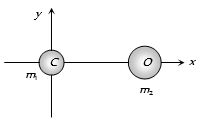
The distance between the carbon atom and the oxygen atom in a carbon monoxide molecule is $1.1\ Å$.  Given, mass of carbon atom is $12\ a.m.u.$ and mass of oxygen atom is $16\ a.m.u.$, calculate the position of the center of mass of the carbon monoxide molecule
  • A
    $6.3\ Å$ from the carbon atom
  • B
    $1\ Å$ from the oxygen atom
  • $0.63\ Å$ from the carbon atom
  • D
    $0.12\ Å $ from the oxygen atom

Answer

Correct option: C.
$0.63\ Å$ from the carbon atom
c
Let carbon atom is at the origin and the oxygen atom is placed at $x$ - axis ${m_1} = 12$, ${m_2} = 16$, $\vec r_1 = 0\hat i + 0\hat j\,{\rm{and}}\,\, \vec r_2 = 1.1\hat i + 0\hat j$

$\mathop r\limits^ \to   = \frac{{{m_1}\mathop {{r_1}}\limits^ \to   + {m_2}\mathop {{r_2}}\limits^ \to  }}{{{m_1} + {m_2}}}$ $ = \frac{{16 \times 1.1}}{{28}}\hat i$  

$\mathop r\limits^ \to   = 0.63\,\hat i$ i.e. $0.63\ Å$ from carbon atom

Need a full question paper?

Generate a complete, print-ready paper with questions like this in minutes — across 16+ boards, with answer keys.

Start Generating Free

Similar questions

A body of mass $5\,kg$ rests on a rough horizontal surface of coefficient of friction $0.2.$ The body is pulled through a distance of $10\,m$ by a horizontal force of $25\, N$. The kinetic energy acquired by it is ......... $J$
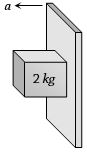
A rough vertical board has an acceleration $‘a’$ so that a $2$ kg block pressing against it does not fall. The coefficient of friction between the block and the board should be
Dimensions of frequency are
The work done in an adiabatic change in a gas depends only on
A big drop is formed by coalescing $1000$ small droplets of water. The surface energy will become :
What is the pressure on a swimmer $20 \,m$ below the surface of water ........ $atm$
A solid object is placed in water contained in an adiabatic container for some time. The temperature of water falls during this period and there is no appreciable change in the shape of the object. The temperature of the solid object:
  1. Must have increased.
  2. Must have decreased.
  3. May have increased.
  4. May have remained constant.
Two particles are in $SHM$ in a straight line. Amplitude $A$ and time period $T$ of both the particles are equal. At time $t=0,$ one particle is at displacement $y_1= +A$ and the other at $y_2= -A/2,$ and they are approaching towards each other. After what time they cross each other ?
One mole of an ideal monoatomic gas is compressed isothermally in a rigid vessel to double its pressure at room temperature, $27\,^oC$.The work done on the gas will be
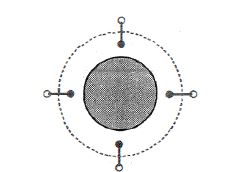
Two small, equal masses are attached by a light weight rod. This object orbits a planet ; the length of the rod is smaller than the radius of the orbit, but not negligible. The rod rotates about its axis in such a way that it remains vertical with respect to the planet. (Assume in each case perturbation maintains the rate of rotation, so that in the co-rotating frame the rod is  still stationary but at an angle to the vertical.)