The distance between the circular plates of a parallel plate condenser $40\,mm$ in diameter, in order to have same capacity as a sphere of radius $1\;metre$ is....$mm$
Medium


Download our appand get started for free
Experience the future of education. Simply download our apps or reach out to us for more information. Let's shape the future of learning together!No signup needed.*
Similar Questions
- 1A cathode ray tube contains a pair of parallel metal plates $1.0\, cm$ apart and $3.0\, cm$ long. A narrow horizontal beam of electron with a velocity $3 \times 10^7\, m/s$ passed down the tube midway between the plates. When a potential difference of $550\, V$ is maintained across the plates, it is found that the electron beam is so deflected that it just strikes the end of one of the plates. Then the specific charge of the electron in $C/kg$ isView Solution
- 2Two charged conducting spheres of radii $a$ and $b$ are connected to each other by a conducting wire. The ratio of charges of the two spheres respectively is:View Solution
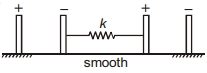
- 3Two charged capacitors have their outer plates fixed and inner plates connected by a spring of force constant ' $k$ '. The charge on each capacitor is q. Find the extension in the spring at equilibriumView Solution
- 4Two unlike charges of magnitude $q$ are separated by a distance $2d$. The potential at a point midway between them isView Solution
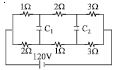
- 5In the circuit shown in figure $C_1 = C_2 = 2$ $\mu F$. Then charge stored inView Solution
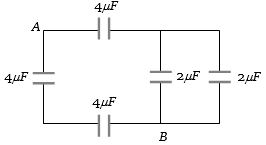
- 6In the circuit as shown in the figure the effective capacitance between $A$ and $B$ is........$\mu \,F$View Solution
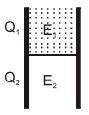
- 7A parallel plate capacitor has a dielectric slab of dielectric constant $K$ between its plates that covers $1 / 3$ of the area of its plates, as shown in the figure. The total capacitance of the capacitor is $C$ while that of the portion with dielectric in between is $C _1$. When the capacitor is charged, the plate area covered by the dielectric gets charge $Q_1$ and the rest of the area gets charge $Q_2$. Choose the correct option/options, igonoring edge effects.View Solution
$(A)$ $\frac{E_1}{E_2}=1$ $(B)$ $\frac{E_1}{E_2}=\frac{1}{K}$ $(C)$ $\frac{Q_1}{Q_2}=\frac{3}{K}$ $(D)$ $\frac{ C }{ C _1}=\frac{2+ K }{ K }$
- 8There is a uniform spherically symmetric surface charge density at a distance $R_0$ from the origin. The charge distribution is initially at rest and starts expanding because of mutual repulsion. The figure that represents best the speed $V(R(t))$ of the distribution as a function of its instantaneous radius $R(t)$ isView Solution
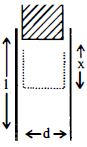
- 9A parallel plate capacitor is made of two plates of length $l$, width $w$ and separated by distance $d$. A dielectric slab ( dielectric constant $K$) that fits exactly between the plates is held near the edge of the plates. It is pulled into the capacitor by a force $F = -\frac{{\partial U}}{{\partial x}}$ where $U$ is the energy of the capacitor when dielectric is inside the capacitor up to distance $x$ (See figure). If the charge on the capacitor is $Q$ then the force on the dielectric when it is near the edge isView Solution
- 10View SolutionConsidering a group of positive charges, which of the following statements is correct?