A cathode ray tube contains a pair of parallel metal plates $1.0\, cm$ apart and $3.0\, cm$ long. A narrow horizontal beam of electron with a velocity $3 \times 10^7\, m/s$ passed down the tube midway between the plates. When a potential difference of $550\, V$ is maintained across the plates, it is found that the electron beam is so deflected that it just strikes the end of one of the plates. Then the specific charge of the electron in $C/kg$ is
Advanced
Download our app for free and get started
Let be the time taken by the electron to move from $A$ and $B$. For the motion along $X$ - axis.
$l = {{\rm{v}}_{\rm{x}}}{\rm{t}} \Rightarrow {\rm{t}} = \frac{l}{{\rm{v}}}$
or $\quad \mathrm{t}=\frac{3 \times 10^{-2} \mathrm{m}}{3 \times 10^{7} \mathrm{m} / \mathrm{s}}=10^{-9} \mathrm{s}$
The force on the electron along $+y$ direction
$\mathrm{F}_{y}=\mathrm{eE}=\frac{\mathrm{eV}}{\mathrm{d}}$
where $\mathrm{V}=550$ volts and $\mathrm{d}=10^{-2} \mathrm{m}$
The acceleration along ty divection is
$a_{y}=\frac{F_{y}}{m}=\frac{e V}{m d}$
For the motion along $+y$ -axis.
${y=0+\frac{1}{2} a_{y} t^{2}}$
or ${\frac{d}{2}=\frac{1}{2}\left(\frac{e V}{m d}\right) t^{2}}$
or $\frac{{\rm{e}}}{{\rm{m}}} = \frac{{{{\rm{d}}^2}}}{{{\rm{V}}{{\rm{t}}^2}}}$
$ = \frac{{{{10}^{ - 4}}}}{{550 \times {{10}^{ - 18}}}} = 1.8 \times {10^{11}}{\rm{C}}/{\rm{kg}}$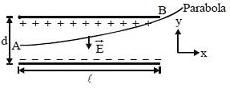

Download our appand get started for free
Experience the future of education. Simply download our apps or reach out to us for more information. Let's shape the future of learning together!No signup needed.*
Similar Questions
- 1Three capacitors of $2\,\mu F,\,3\,\mu F$ and $6\,\mu F$ are joined in series and the combination is charged by means of a $24\, volt$ battery. The potential difference between the plates of the $6\,\mu F$ capacitor is.......$volt$View Solution
- 2Three capacitors $2$ $\mu F$, $3$ $\mu F$ and $5$ $\mu F$ can withstand voltages to $3\,V, 2\,V$ and $1\,V$ respectively. Their series combination can withstand a maximum voltage equal to.....$Volts$View Solution
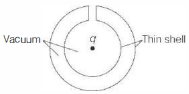
- 3A positive charge $q$ is placed at the centre of a neutral hollow cylindrical conducting shell with its cross-section as shown in the figure below. Which one of the following figures correctly indicates the induced charge distribution on the conductor? (Ignore edge effects)View Solution
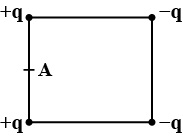
- 4Four electric charges $+q,+q, -q$ and $-q$ are placed at the comers of a square of side $2L$ (see figure). The electric potential at point $A,$ midway between the two charges $+q$ and $+q,$ isView Solution
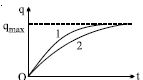
- 5The charge across the capacitor in two different $RC$ circuits $1$ and $2$ are plotted as shown in figure. Identify the correct statement$(s)$ related to the $R_1, R_2, C_1 $ and $C_2$ of the two $RC$ circuits.View Solution
- 6A $4\ \mu F$ capacitor, a resistance of $2.5 \,MW$$\Omega$ is in series with $12\, V$ battery. Find the time after which the potential difference across the capacitor is $3$ times the potential difference across the resistor.......$s$ [Given $ln(2)= 0.693$]View Solution
- 7Three capacitors are connected to $D.C.$ source of $100\;volts$ shown in the adjoining figure. If the charge accumulated on plates of ${C_1},\;{C_2}$ and ${C_3}$ are ${q_a},\;{q_b},\;{q_c},{q_d}.{q_e}$ and ${q_f}$ respectively, thenView Solution
- 8Two capacitors $C_1$ and $C_2$ are connected in a cirucit as shown in figure. The potential difference $(V_A -V_B)$ is.....$V$View Solution
- 9The electrostatic potential $V$ at a point on the circumference of a thin non-conducting disk of radius $r$ and uniform charge density $\sigma$ is given by equation $V = 4 \sigma r$. Which of the following expression correctly represents electrostatic energy stored in the electric field of a similar charged disk of radius $R$?View Solution
- 10View SolutionWhen a test charge is brought in from infinity along the perpendicular bisector of an electric dipole, the work done is ..........