MCQ
The distance between the points $(\cos\theta,\sin\theta)$ and $(\sin\theta,-\cos\theta)$ is:
  • A
    $\sqrt{3}$
  • $\sqrt{2}$
  • C
    $2$
  • D
    $1$

Answer

Correct option: B.
$\sqrt{2}$
We have to find the distance between $\text{A}(\cos\theta,\sin\theta)$ and $\text{B}(\sin\theta,-\cos\theta).$
In general, the distance between $A(x_1, y_1)$ and $B(x_2, y_2)$ is given by,
$\text{AB}=\sqrt{(\text{x}_2-\text{x}_1)^2+(\text{y}_2-\text{y}_1)^2}$
So,
$\text{AB}=\sqrt{(\sin\theta-\cos\theta)^2+(-\cos\theta-\sin\theta)^2}$
$=\sqrt{2(\sin^2\theta+\cos^2\theta)}$
But according to the trigonometric identity,
$\sin^2\theta+\cos^2\theta=1$
Therefore,
$\text{AB}=\sqrt{2}$

Need a full question paper?

Generate a complete, print-ready paper with questions like this in minutes — across 16+ boards, with answer keys.
Start Generating Free

Similar questions

A chord of a circle subtends an angle of $60^{\circ}$ at the centre. If the length of the chord is 100 cm, find the area of the major segment.
If the $n^{\text {th }}$ term of an $A.P.$ is $(2 n+1)$, then the sum of its first three terms is
$\left(\frac{2}{3} \sin 0^{\circ}-\frac{4}{5} \cos 0^{\circ}\right)$ is equal to:
$\frac{2\tan^230^\circ\sec^252^\circ\sin^238^\circ}{\text{cosec}^270^\circ-\tan^220^\circ}=?$
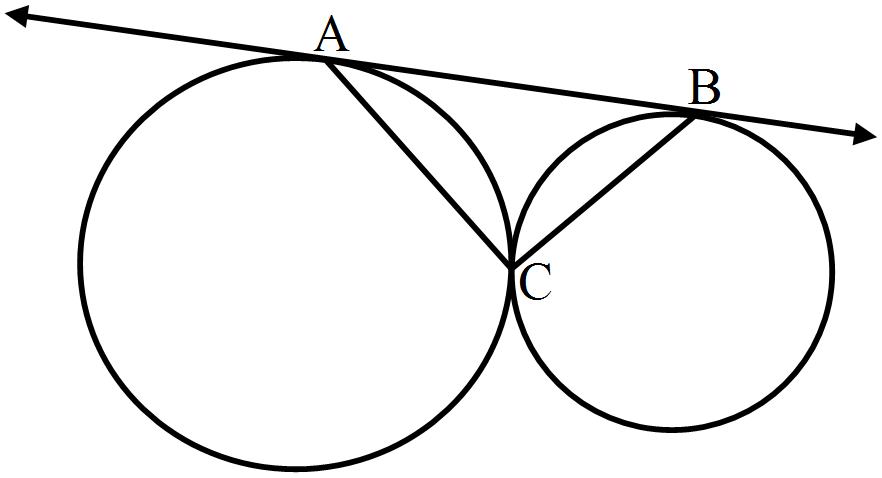
In the given figure, two circles touch each other at $C$ and $AB$ is a tangent to both the circles. The measure of $\angle\text{ACB}$ is :​​​​​​​
Mark the correct alternative in the following:
$\text{If }\frac{5+9+13+, ....\text{ to n terms}}{7+9+11+, .....\text{to }(\text{n}+1)\text{ term}}=\frac{17}{16},\text{then n }=$
The ratio in which (4, 5) divides the join of (2, 3) and (7, 8) is:
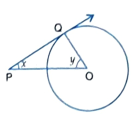
In Fig. PQ is a tangent to the circle with centre $O$. If $\angle O P Q=x, \angle P O Q=y$, then $x+y$ is
Image
Directions : In the following questions, the Assertions $(A)$ and Reason $(s)\ (R)$ have been put forward. Read both the statements carefully and choose the correct alternative from the following:
Assertion : Pair of linear equations : $9x+ 3y+ 12 = 0, 8x+ 6y+ 24 = 0$ have infinitely many solutions.
Reason : Pair of linear equations $a_1x+b_1y + c_1=0$ and $a_2x+b_2y+c_2=0$ have infinitely many solutions, if $\frac{\text{a}_1}{\text{a}_2}=\frac{\text{b}_1}{\text{b}_2}=\frac{\text{c}_1}{\text{c}_2}$
If altitude of the sun is $60^\circ,$ the height of a tower which casts a shadow of length $30m$ is :