MCQ
The distance between the vertex and the centre of mass of a uniform solid planar circular segment of angular size $\theta$ and radius $R$ is given by
  • $\frac{4}{3} R \frac{\sin (\theta / 2)}{\theta}$
  • B
    $R \frac{\sin (\theta / 2)}{\theta}$
  • C
    $\frac{4}{3} R \cos \left(\frac{\theta}{2}\right)$
  • D
    $\frac{2}{3} R \cos \theta$

Answer

Correct option: A.
$\frac{4}{3} R \frac{\sin (\theta / 2)}{\theta}$
a
(a)

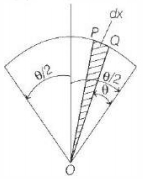
Refer to figure below,

Consider a differentiable are of angle $d \theta$.

Area of $\triangle O P Q=\frac{1}{2} \times P Q \times O P$

$=\frac{1}{2} R d \theta \times R=\frac{1}{2} R^2 d \theta$

Centre of mass of this $\triangle O P Q$ is at a distance of $\frac{2}{3} R \cos \theta$ from $O$.

So, position of centre of mass of complete segment is

$\bar{y}=\int y d m / \int d m$

$\bar{y}=\frac{\int \limits_0^{\theta / 2} \frac{2 R}{3} \cos \theta \cdot \rho \frac{r^2}{2} d \theta}{\int \limits_0^{\theta / 2} \rho \frac{r^2}{2} d \theta}$

where, $\rho=$ mass density.

$\therefore \quad \bar{y} =\frac{\frac{2 r}{3} \int \limits_0^{\theta / 2} \cos \theta d \theta}{\int \limits_0^{\theta / 2} d \theta}=2 \frac{R}{3} \cdot \frac{\sin \theta / 2}{\theta / 2}$

$=\frac{4}{3} R \frac{\sin (\theta / 2)}{\theta}$
Need a full question paper?

Generate a complete, print-ready paper with questions like this in minutes — across 16+ boards, with answer keys.

Start Generating Free

Similar questions

The function of time representing a simple harmonic motion with a period of $\frac{\pi}{\omega}$ is :
The molar specific heat at constant pressure of an ideal gas is $\big(\frac{ 7}{2}\big) \text{R. }$The ratio of specific heat at constant pressure to that at constant volume is.
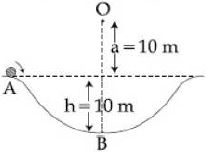
A particle of mass $20\,g$ is released with an initial velocity $5\,m/s$ along the curve from the point $A,$ as shown in the figure. The point $A$ is at height $h$ from point $B.$ The particle slides along the frictionless surface. When the particle reaches point $B,$ its angular momentum about $O$ will be ......... $kg - m^2/s$. [Take $g = 10\,m/s^2$ ]
A metal wire of length $L_1$ and area of cross section $A$ is attached to a rigid support. Another metal wire of length $L_2$ and of the same cross sectional area is attached to the free end of the first wire. A body of mass $M$ is then suspended from the free end of the second wire. If $Y_1$ and $Y_2$ are the Youngs moduli of the wires respectively, the effective force constant of the system of two wires is :
If a cycle wheel of radius $4 \,m$ completes one revolution in two seconds. Then acceleration of a point on the cycle wheel will be
A wire suspended vertically from one of its ends is stretched by attaching a weight of $200\ N$ to the lower end. The weight stretches the wire by $1\ mm$. Then the elastic energy stored in the wire ......... $J$
Two bodies of masses $m,$ and $m,$ have same momentum. The ratio of their $KE$ is:
Unit vector does not have any .......
A body of mass $‘m’$ is dropped from a height of $‘h’$. Simultaneously another body of mass $2m$ is thrown up vertically with such a velocity $v$ that they collide at the height $h/2$. If the collision is perfectly inelastic, the velocity at the time of collision with the ground will be :
An aircraft executes a horizontal loop with a speed of $150\, m/s$ with its wings banked at an angle of $12^o$. The radius of the loop is ..........  $km$ $(g = 10\, m/s^2 \; and\; \tan 12^o = 0.2125)$