MCQ
The function of time representing a simple harmonic motion with a period of $\frac{\pi}{\omega}$ is :
  • A
    $\sin (\omega t)+\cos (\omega t)$
  • B
    $\cos (\omega t)+\cos (2 \omega t)+\cos (3 \omega t)$
  • C
    $\sin ^{2}(\omega t)$
  • $3 \cos \left(\frac{\pi}{4}-2 \omega t\right)$

Answer

Correct option: D.
$3 \cos \left(\frac{\pi}{4}-2 \omega t\right)$
d
Time period $T =\frac{2 \pi}{\omega^{\prime}}$

$\frac{\pi}{\omega}=\frac{2 \pi}{\omega^{\prime}}$

$\omega^{\prime}=2 \omega \rightarrow$ Angular frequency of $SHM$

Option $(3):$

$\sin ^{2} \omega t=\frac{1}{2}\left(2 \sin ^{2} \omega t\right)=\frac{1}{2}(1-\cos 2 \omega t)$

Angular frequency of $\left(\frac{1}{2}-\frac{1}{2} \cos 2 \omega t\right)$ is $2 \omega$

Option $(4):$

Angular frequency of $SHM$

$3 \cos \left(\frac{\pi}{4}-2 \omega t\right)$ is $2 \omega$

So option $(3)\, \& (4)$ both have angular frequency $2 \omega$ but option $(4)$ is direct answer.
Need a full question paper?

Generate a complete, print-ready paper with questions like this in minutes — across 16+ boards, with answer keys.

Start Generating Free

Similar questions

The position of a particle at time $t$ is given by the relation $x(t) = \left( {\frac{{{v_0}}}{\alpha }} \right)\,\,(1 - {e^{ - \alpha t}})$, where ${v_0}$ is a constant and $\alpha > 0$. The dimensions of ${v_0}$ and $\alpha $ are respectively
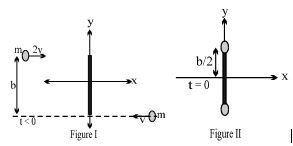
One ice skater of mass $m$ moves with speed $2v$ to the right, while another of the same mass $m$ moves with speed $v$ toward the left, as shown in figure $I$. Their paths are separated by $a$ distance $b$. At $t = 0$, when they are both at $x = 0$, they grasp a pole of length $b$ and negligible mass. For $t > 0$, consider the system as a rigid body of two masses $m$ separated by distance $b$, as shown in figure $II$. Which of the following is the correct formula for the motion after $t = 0$ of the skater initially at $y = b/2?$
A body having its centre of mass at the origin has three of its particles at $(a, 0, 0), (0, a, 0), (0, 0, a).$ The moments of inertia of the body about the $X$ and $Y$ axes are $0.20\ \ce{kg-m^2}$ each. The moment of inertia about the $Z-$axis:
stationary source is emitting sound at a fixed frequency $f_0$, which is reflected by two cars approaching the source. The difference between the frequencies of sound reflected from the cars is $1.2\%$ of $f_0$. What is the difference in the speeds of the cars (in $km$ per hour) to the nearest integer ..... $km/hr$ ? The cars are moving at constant speeds much smaller than the speed of sound which is $330$ $ms^{-1}$.
In a harmonium the intermediate notes between a note and its octave form
The potential energy of a body of mass $m$ is given by $U = ax + by$, where $x$ and $y$ are the position coordinates of the particle. The acceleration of the particle is
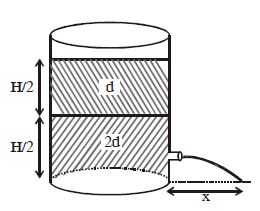
A container of large uniform cross-sectional area $A$ is resting on a horizontal surface holds two immiscible, non-viscous and incompressible liquids of densities $d$ and $2d$ each of height $\frac{H}{2}$ as shown. The lower density of liquid is open to atmosphere. A small hole is made on the wall of container at height $h\left( {h < \frac{H}{2}} \right)$. The initial speed of efflux of the liquid at the hole is
Absolute zero $(0\, K)$ is that temperature at which
A thin uniform circular disc of mass $M$ and radius $R$ is rotating in a horizontal plane about an axis passing through its centre and perpendicular to its plane with an angular velocity $\omega $. Another disc of same dimension but of mass $M/4$ is placed gently on the first disc coaxially. The angular velocity of the system now is            
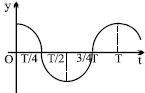
The displacement-time graph of a particle executing $SHM$ is shown. Which of the following statements is/are true ?