Question
The distance of a galaxy is of the order of $10^{25}m$. Calculate the order of magnitude of time taken by light to reach us from the galaxy.

Answer

According to the problem, distance of the galaxy = $10^{25}m$. Speed of light = $3 \times 10^8m/s$ Hence, time taken by light to reach us from galaxy is, $\text{t}=\frac{\text{Distance}}{\text{Speed}}=\frac{10^{25}\text{m}}{3\times10^8\text{m/s}}=\frac{1}{3}\times10^{17}$ $=\frac{10}{3}\times10^{16}=3.33\times10^{16}\text{s}$

Need a full question paper?

Generate a complete, print-ready paper with questions like this in minutes — across 16+ boards, with answer keys.
Start Generating Free

Similar questions

The battery discussed in the previous question is suddenly disconnected. Is a current induced in the other loop? If yes, when does it start and when does it end? Do the loops attract each other or repel?
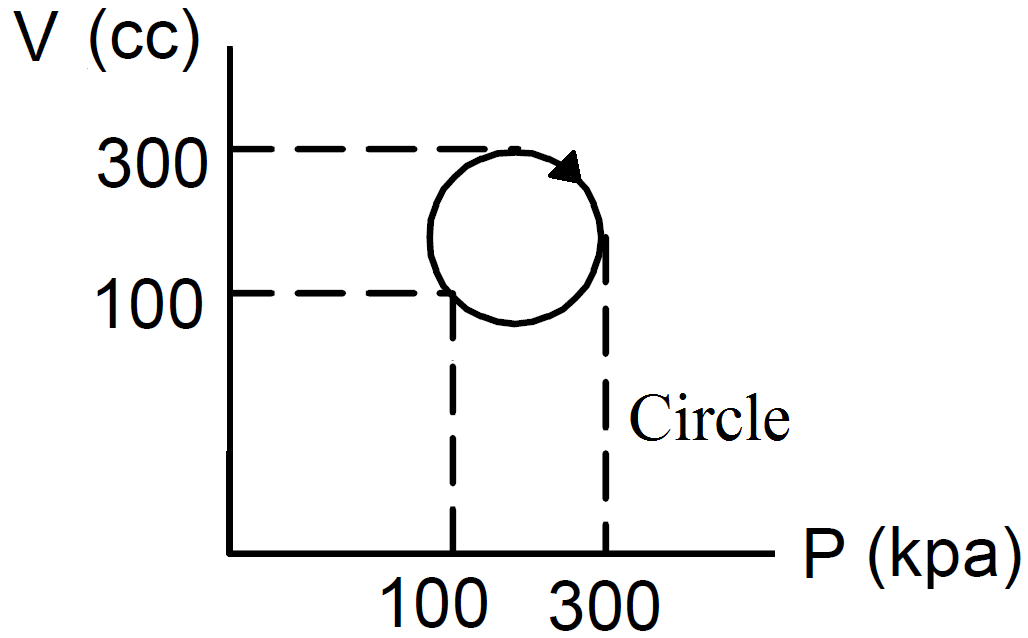
Calculate the heat absorbed by a system in going through the cyclic process shown in figure.
Differentiate between forced oscillations and supported oscillations.
A Galilean telescope is 27cm long when focused to form an image at infinity. If the objective has a focal length of 30cm, what is the focal length of the eyepiece?
In the given progressive wave $​​​​\text{y}=5\sin(100\pi\text{t+0.4x})$ where y and x are in m, t is in s. What is the:
Wave length
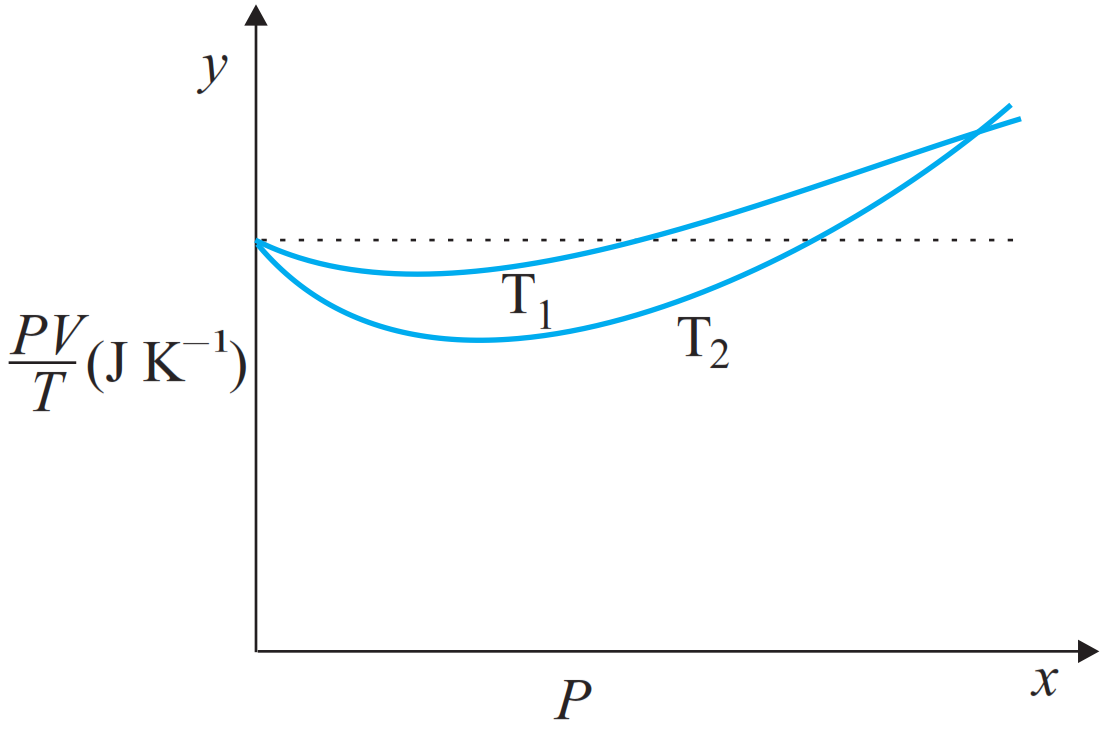
Shows plot of $\frac{P V}{T}$ versus $P$ for $1.00 \times 10^{-3} \mathrm{~kg}$ of oxygen gas at two different temperatures: Which is true, $T_1>T_2$ or $T_1$ $<T_2$ ?
A hydraulic automobile lift is designed to lift cars with maximum mass of 300kg. The area of cross-section of the piston carrying the load is $425cm^2$. What maximum pressure would the smaller piston have to bear?
Water flows through a horizontal tube as shown in If the difference of heights of water column in the vertical tubes is 2cm, and the areas of cross-section at A and B are $4cm^2$ and $2cm^2$ respectively, find the rate of flow of water across any section.
What is the difference between velocity-time graphs in uniform motion and uniformly accelerated motion?
Find the area bounded by the curve $y = e^{-x}$, the X-axis and the Y-axis.