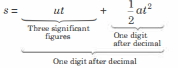
The distance $s$ travelled by a particle in time $t$ is $s=u t-\frac{1}{2} \,g t^{2}$. The initial velocity of the particle was measured to be $u=1.11 \pm 0.01 \,m / s$ and the time interval of the experiment was $t=1.01 \pm 0.1 \,s$. The acceleration was taken to be $g=9.8 \pm 0.1 \,m / s ^{2}$. With these measurements, the student estimates the total distance travelled. How should the student report the result?
KVPY 2017, Diffcult


Download our appand get started for free
Experience the future of education. Simply download our apps or reach out to us for more information. Let's shape the future of learning together!No signup needed.*
Similar Questions
- 1In the density measurement of a cube, the mass and edge length are measured as $(10.00 \pm 0.10)\,\,kg\,$ and $(0.10 \pm 0.01)\,\,m\,$ respectively. The error in the measurement of density isView Solution
- 2View SolutionDimensional formula of heat energy is
- 3View SolutionWhich of the following is not the unit of energy
- 4$Henry/ohm$ can be expressed inView Solution
- 5In a particular system of units, a physical quantity can be expressed in terms of the electric charge $c$, electron mass $m_c$, Planck's constant $h$, and Coulomb's constant $k=\frac{1}{4 \pi \epsilon_0}$, where $\epsilon_0$ is the permittivity of vacuum. In terms of these physical constants, the dimension of the magnetic field is $[B]=[c]^\alpha\left[m_c\right]^\beta[h]^\gamma[k]^\delta$. The value of $\alpha+\beta+\gamma+\delta$ is. . . . .View Solution
- 6While measuring the acceleration due to gravity by a simple pendulum, a student makes a positive error of $1\%$ in the length of the pendulum and a negative error of $3\%$ in the value of time period. His percentage error in the measurement of $g$ by the relation $g = 4{\pi ^2}\left( {l/{T^2}} \right)$ will be ........ $\%$View Solution
- 7The density of a material is $CGS$ system of units is $4\,g/cm^3$. In a system of units in which unit of length is $10\,cm$ and unit of mass is $100\,g$, the value of density of material will beView Solution
- 8$Assertion$ : Specific gravity of a fluid is a dimensionless quantity.View Solution
$Reason$ : It is the ratio of density of fluid to the density of water
- 9Match the following two coloumnsView Solution
Column $-I$ Column $-II$ $(A)$ Electrical resistance $(p)$ $M{L^3}{T^{ - 3}}{A^{ - 2}}$ $(B)$ Electrical potential $(q)$ $M{L^2}{T^{ - 3}}{A^{ - 2}}$ $(C)$ Specific resistance $(r)$ $M{L^2}{T^{ - 3}}{A^{ - 1}}$ $(D)$ Specific conductance $(s)$ None of these - 10$Newton/metr{e^{\rm{2}}}$ is the unit ofView Solution