Question
The Doppler effect is applicable for

Answer

The Doppler effect is applicable for both sound and light waves.

Need a full question paper?

Generate a complete, print-ready paper with questions like this in minutes — across 16+ boards, with answer keys.

Start Generating Free

Similar questions

A Hydrogen atom and a $L{i^{ + + }}$ ion are both in the second excited state. If ${l_H}$ and ${l_{Li}}$ are their respective electronic angular momenta, and ${E_H}$ and ${E_{Li}}$ their respective energies, then
A block of ice with mass $m$ falls into a lake. After impact, a mass of ice $m/5$ melts. Both the block of ice and the lake have a temperature of $^o C$. If $L$ represents the heat of fusion, the minimum distance the ice fell before striking the surface is
A solid metallic cube having total surface area $24\;m ^{2}$ is uniformly heated. If its temperature is increased by $10\,^{\circ} C$, calculate the increase in volume of the cube $\left(\right.$ Given $\left.: \alpha=5.0 \times 10^{-4}{ }^{\circ} C ^{-1}\right)$
The instantaneous values of current and emf in an ac circuit are $I = 1/\sqrt 2 \sin 314\,t \, amp$ and $E = \sqrt 2 \sin (314\,t - \pi /6)V$ respectively. The phase difference between $E$ and $I$ will be
$\begin{array}{*{20}{c}}
  {Ph - C - C{H_3}} \\ 
  {||\,\,\,} \\ 
  {O\,\,\,\,} 
\end{array}$ $\xrightarrow[{(ii)\,\Delta }]{{(i)\,aq.\,{K_2}C{O_3}}}$ Product is
A person wears glasses of power $-2.5 \,D$. The defect of the eye and the far point of the person without the glasses are respectively
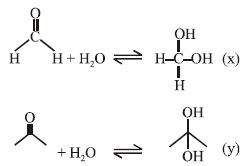
$x$ and $y$ respectively are
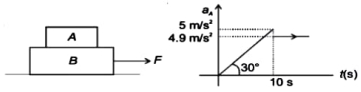
Acceleration of block $A$ varies with time as shown in figure the value of coefficient of kinetic friction between block $A$ and $B$ is the value of coefficient of kinetic friction between block $A$ and $B$ is .............. 
Two coherent sources of intensities, $I_1$ and $I_2$ produce an interference pattern. The maximum intensity in the interference pattern will be
If the initial velocity in horizontal direction of a projectile is unit vector $\hat{i}$ and the equation of trajectory is $y =5 x (1- x )$. The $y$ component vector of the initial velocity is.

(Take $g=10\,m / s ^{2}$ )