MCQ
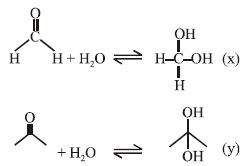
$x$ and $y$ respectively are
  • A
    $x = 0.2\,\%,\,\,y = 99.95\,\%$
  • $x =99.9\,\%,\,\,y = 0.2\,\%$
  • C
    $x = 0.2\,\%,\,\,y = 0.2\,\%$
  • D
    $x = 99.9\,\%,\,\,y = 99.9\,\%$

Answer

Correct option: B.
$x =99.9\,\%,\,\,y = 0.2\,\%$
b
$HCHO$ forms stable hydrate.

Need a full question paper?

Generate a complete, print-ready paper with questions like this in minutes — across 16+ boards, with answer keys.
Start Generating Free

Similar questions

A block of wood is floating on water at $0^{\circ} C$ with volume $V_0$ above water. When the temperature of water increases from $0$ to $10^{\circ} C$, the change in the volume of the block that is above water is best described schematically by the graph.
Two long straight wires $P$ and $Q$ carrying equal current $10\,A$ each were kept parallel to each other at $5\,cm$ distance. Magnitude of magnetic force experienced by $10\,cm$ length of wire $P$ is $F_1$. If distance between wires is halved and currents on them are doubled, force $F_2$ on $10\,cm$ length of wire $P$ will be :
Light of frequency $v$ is incident on a certain photoelectric substance with threshold frequency $v_0$. The work function for the substance is
The mechanical equivalent of heat $J$ is
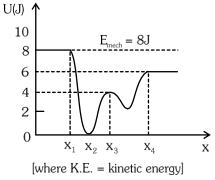
Given below is the plot of a potential energy function $U(x)$ for a system, in which a particle is in one dimensional motion, while a conservative force $F(x)$ acts on it. Suppose that $E_{\text {mech }}=8\, {J}$, the incorrect statement for this system is:
A simple pendulum is executing simple harmonic motion with a time period $T$. If the length of the pendulum is increased by $21\%$, the percentage increase in the time period of the pendulum of increased length is ..... $\%$
The average life $T$ and the decay constant $\lambda $ of a radioactive nucleus are related as
Which of the following will not give $D.N.P.$ test ?
Four ray $1, 2, 3$ and $4$ are incident normally on the face $P Q$ of an isosceles prism $P Q R$ with apex angle $\angle Q=120^{\circ}$. The refractive indices of the material of the prism for the above rays $1,2,3$ and $4$ are $1.85$, $1.95,2.05$ and $2.15$ respectively and the surrounding medium is air. Then, the rays emerging from the face $Q R$ are
A particle is moving in a straight line and passes through a point $O$ with a velocity of $6\;m{s^{ - 1}}.$ The particle moves with a constant retardation of $2\;m{s^{ - 2}}\;$ for $4$ s and there after moves with constant velocity. How long after leaving $O$ does the particle return to $O$..........$s$