Question
The drift current in a reverse-biased p-n junction increases in magnitude if the temperatu,re of the junction is increased. Explain this on the basis of creation of hole-electron pairs.

Answer

When the temperature of a reverse-biassed p‒n junction is increased, the breaking of bonds takes place because of the increase in the thermal energy of the charge carriers. Drift current is due to the flow of the minority carriers across the junction. So, when a p‒n junction is reverse biassed, the applied voltage supports the flow of minority charge carriers across the junction. Thus, the drift current increases with increase in temperature in a reverse biassed p‒n junction.

Need a full question paper?

Generate a complete, print-ready paper with questions like this in minutes — across 16+ boards, with answer keys.
Start Generating Free

Similar questions

Just as precise measurements are necessary in science, it is equally important to be able to make rough estimates of quantities using rudimentary ideas and common observations. Think of ways by which you can estimate the following (where an estimate is difficult to obtain, try to get an upper bound on the quantity):
The mass of an elephant.
Why are the magnification properties of microscopes and telescopes defined in terms of the ratio of angles and not in terms of the ratio of sizes of objects and images?
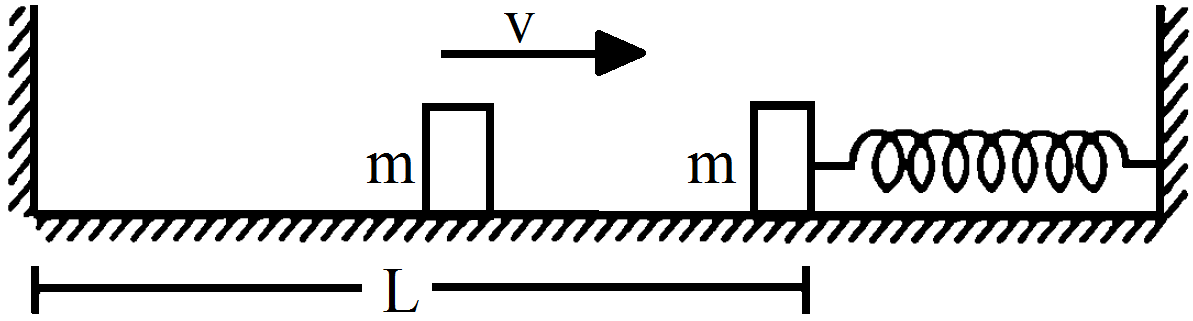
The left block in figure moves at a speed v towards the right block placed in equilibrium. All collisions to take place are elastic and the surfaces are frictionless. Show that the motions of the two blocks are periodic. Find the time period of these periodic motions. Neglect the widths of the blocks.

Three equal masses m are placed at the corners of an equilateral triangle of side a. What is the work done in doing this?
Molecules in air in the atmosphere are attracted by gravitational force of the earth. Explain why all of them do not fall into the earth just like an apple falling from a tree.
The density of an ideal gas is 1.25 × 10⁻³gcmat STP. Calculate the molecular weight of the gas.
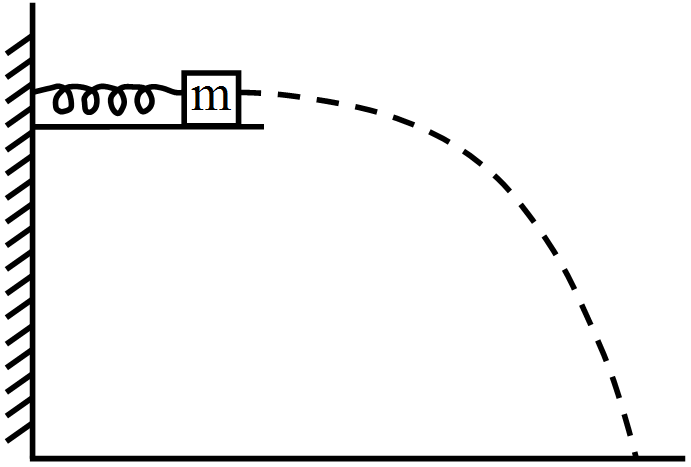
A small block of mass is pressed against a horizontal spring fixed at one end to compress the spring through 5.0cm. When released the block moves horizontally till it leaves the spring. Where will it hit the ground at a distance 2m below the slab?
[k = 100N/ m, m = 100g)

A particle executes the motion described by $\text{x}(\text{t})=\text{x}_0(1-\text{e}^{-\gamma\text{t}});\text{t}\ge0,\text{x}_0>0.$
Where does the particle start and with what velocity?
A particle is projected with a speed u at an angle $\theta$ with the horizontal. Consider a small part of its path near the highest position and take it approximately to be a circular arc. What is the radius of this circle? This radius is called the radius of curvature of the curve at the point.
Rain is falling vertically with a speed of 30m s-1. A woman rides a bicycle with a speed of 10ms-1 in the north to south direction. What is the direction in which she should hold her umbrella?