Question
The drift current in a reverse-biased p-n junction increases in magnitude if the temperatu,re of the junction is increased. Explain this on the basis of creation of hole-electron pairs.

Answer

When the temperature of a reverse-biassed p‒n junction is increased, the breaking of bonds takes place because of the increase in the thermal energy of the charge carriers. Drift current is due to the flow of the minority carriers across the junction. So, when a p‒n junction is reverse biassed, the applied voltage supports the flow of minority charge carriers across the junction. Thus, the drift current increases with increase in temperature in a reverse biassed p‒n junction.

Need a full question paper?

Generate a complete, print-ready paper with questions like this in minutes — across 16+ boards, with answer keys.
Start Generating Free

Similar questions

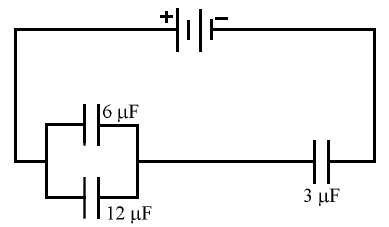
  1. In the following arrangement of capacitors, the energy stored in the 6 μF capacitor is E. Find the value of the following:
  2. Energy stored in 12 μF capacitor.
  3. Energy stored in 3 μF capacitor.
  4. Total energy drawn from the battery.
A resistor of $12 \Omega$, a capacitor of $14 \Omega$ reactance and a pure inductor of inductance 0.1 H are joined in series and an alternating current of 200 V, 50 Hz is joined with them. Compute: (i) current in the circuit and (ii) phase angle between current and the voltage (Take $\pi=3$ ).
  1. Derive the mathematical expression for law of radioactive decay for a sample of a radioactive nucleus.
  2. How is the mean life of a given radioactive nucleus related to the decay constant?
Find the ratio of the linear momenta of two particles of masses 1.0kg and 4.0kg if their kinetic energies are equal.
Consider a variation of the previous problem (figure). Suppose the circular loop lies in a vertical plane. The rod has a mass m. The rod and the loop have negligible resistances but the wire connecting O and C has a resistance R. The rod is made to rotate with a uniform angular velocity $\omega$ in the clockwise direction by applying a force at the midpoint of OA in a direction perpendicular to it. Find the magnitude of this force when the rod makes an angle $\theta$ with the vertical.
When $1.0 \times 10^{12}$ electrons are transferred from one conductor to another, a potential difference of 10V appears between the conductors. Calculate the capacitance of the two-conductor system.
A short magnet is moved along the axis of a conducting loop. Show that the loop repels the magnet if the magnet is approaching the loop and attracts the magnet if it is going away from the loop.
A circular loop of radius 20cm carries a current of 10A. An electron crosses the plane of the loop with a speed of $2.0 \times 10^6m/s.$ The direction of motion makes an angle of 30° with the axis of the circle and passes through its centre. Find the magnitude of the magnetic force on the electron at the instant it crosses the plane.
Explain with example, whether the neutron-proton ratio in a nucleus increases or decreases due to $\beta-$decay.
Two blocks of equal mass m are tied to each other through a light string. One of the blocks is pulled along the line joining them with a constant force F. Find the tension in the string joining the blocks.